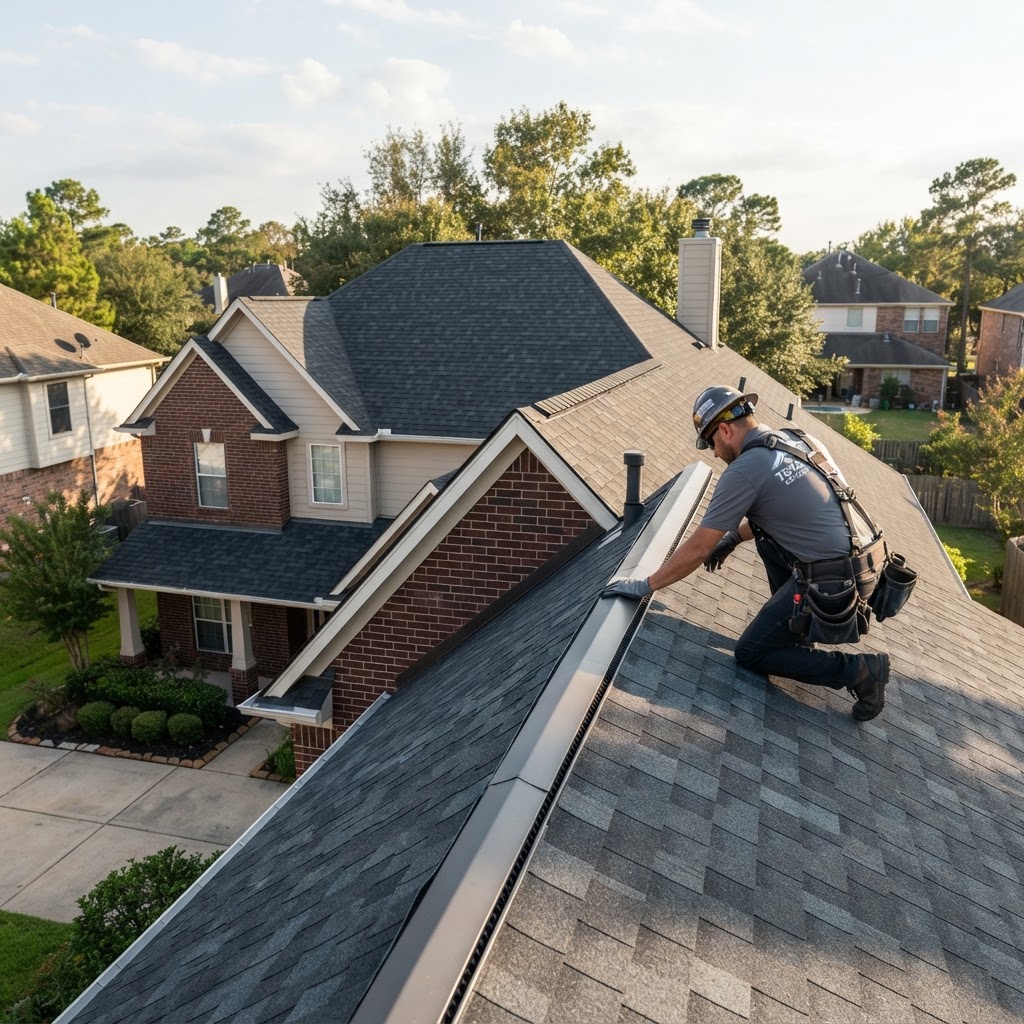
Your Attic Is Destroying Your Roof From the Inside Out: How Houston Homeowners Can Stop It
Most Houston homeowners blame storm damage when their roof fails early — but the real culprit is often hiding in the attic. Here's how superheated, moisture-saturated air silently shortens your roof's life and what you can do about it before your next inspection.
If you've ever climbed into a Houston attic in July, you already know it's a different world up there. We've recorded attic temperatures above 160°F in homes across The Woodlands and Katy — hot enough to warp OSB decking, cook adhesive strips on shingles, and accelerate UV breakdown from the inside before the sun even gets a chance to do it from the outside.
Most homeowners think roofs fail because of hail, wind, or age. Those things matter. But in 20+ years of roofing across Greater Houston, the single most overlooked cause of premature roof failure is inadequate attic ventilation combined with trapped humidity. And the frustrating part? It's almost always preventable.
Why Houston's Climate Makes This Worse Than Almost Anywhere Else
Houston sits in a climate zone that punishes roofs from every direction. You're dealing with:
- Extreme summer heat: Ambient temps regularly hit 100°F+, pushing attic temps to 150–165°F in poorly ventilated spaces
- Year-round humidity: Houston averages 75–90% relative humidity, meaning moisture is constantly trying to migrate into your attic from living spaces below
- Gulf moisture events: Even outside hurricane season, tropical moisture systems push dense, humid air inland — we saw this repeatedly during the 2024 and 2025 seasons
- Sudden freeze events: The February 2021 freeze (Winter Storm Uri) and the January 2024 freeze event showed what happens when trapped attic moisture meets rapid temperature swings — condensation, mold, and rotting decking
When you combine 160°F summer heat with 80% humidity cycling through your attic, you're essentially pressure-cooking your roof system from underneath.
What's Actually Happening to Your Shingles
Here's the part most homeowners don't realize: shingles are warrantied and engineered based on temperature ranges. GAF's Timberline HDZ shingles — one of the most popular products we install in Houston — carry a Limited Lifetime warranty, but that warranty assumes the shingle is operating within a reasonably ventilated system. GAF's own installation guidelines require proper intake and exhaust ventilation ratios. If you violate those specs, you can void your material warranty entirely.
What heat does to an unventilated roof:
- Adhesive strip failure: The factory-applied thermal seal strip that bonds shingles together softens and degrades. Once it loses adhesion, wind uplift resistance drops dramatically — meaning a 60 mph gust does what it wasn't supposed to do.
- Granule loss acceleration: Asphalt binders soften under sustained high heat. Granules — the protective layer that blocks UV — shed faster than normal. We've pulled shingles off 8-year-old Houston roofs that looked 20 years old because the attic beneath them was running at 158°F every summer day.
- Decking delamination: OSB sheathing absorbs moisture vapor during humid months and then bakes dry during heat spikes. Repeat that cycle for a few years and you get delamination — the layers separate, fasteners lose holding strength, and now you have a structural problem, not just a cosmetic one.
- Ridge cap failure: The highest point of your roof is the hottest. On unventilated homes, ridge caps often fail 3–5 years before the field shingles do.
The Ventilation Math Most Contractors Skip
The building code standard is 1 square foot of net free ventilation area (NFVA) per 150 square feet of attic floor space (or 1:300 with a vapor barrier). But code minimum and "adequate for Houston" are two different things.
Here's what a proper balanced system looks like:
- Intake ventilation at the soffits (continuous soffit vents or individual vents every 2 feet)
- Exhaust ventilation at or near the ridge (ridge vent, box vents, or powered fans)
- The ratio matters: You want roughly 50% intake, 50% exhaust. An imbalanced system — all ridge vent, blocked soffits — actually creates negative pressure that pulls hot outside air in through gaps in your roofline
The biggest mistake we see in Houston-area homes, especially in subdivisions built in the 1990s and early 2000s in areas like Sugar Land, Pearland, and Spring, is soffit vents that are completely blocked by insulation. An HVAC contractor blows in extra insulation for energy efficiency — and inadvertently covers every soffit vent. The attic goes from mediocre ventilation to zero intake overnight. If your home was re-insulated in the last 10 years and no one checked your soffit vents afterward, there's a real chance you have this problem right now.
How to Check Your Own Attic Ventilation (Without Hiring Anyone)
You don't need a contractor to do a first-pass assessment:
- Go into your attic on a summer afternoon (safely — bring water, don't stay long). If it feels like a sauna and you can see daylight through your ridge vent but the space still isn't moving air, you likely have blocked intake.
- Look at your soffit vents from inside: Shine a flashlight toward the eaves. You should see light coming through. If insulation is pushed all the way to the edge, your intake is blocked.
- Check for moisture staining on rafters and decking: Dark staining, soft spots, or visible mold growth means moisture has been accumulating — likely during winter months or after Gulf moisture events.
- Feel the underside of your decking after a hot day: It should be hot but dry. If it feels damp or you see condensation, you have a moisture migration problem from the living space below.
- Count your exhaust vents: For a 2,000 sq ft attic footprint, you need roughly 13–14 square feet of NFVA. One box vent gives you about 50 square inches. Do the math — most homes with three box vents are severely under-ventilated.
The Fix: What a Proper Remediation Looks Like
If you've confirmed a ventilation problem, here's the typical scope of work and real cost ranges for Houston in 2026:
- Clearing blocked soffit vents + adding baffles (rafter vents): $300–$800 depending on attic size and insulation depth. This is often the highest-ROI fix available.
- Adding or replacing ridge vent: $400–$900 for a standard gable home. Ridge vent is almost always superior to box vents because it spans the entire peak and works passively.
- Adding a solar-powered attic fan: $350–$600 installed. Useful in homes where geometry makes passive ventilation difficult (hip roofs, complex rooflines). Note: these are supplemental, not replacements for passive balanced systems.
- Full ventilation remediation on a complex roof: $1,200–$2,500. Worth every dollar if it adds 5–8 years to a roof that would otherwise need replacement.
For comparison, a full roof replacement on a 2,500 sq ft Houston home currently runs $14,000–$22,000 depending on materials and complexity. Spending $800 on ventilation to protect that investment is one of the most rational home maintenance decisions you can make.
One More Thing About Insurance
Here's something worth knowing before you file that next claim: insurance adjusters for carriers like State Farm, Allstate, and USAA are increasingly trained to look for signs of improper ventilation as a contributing factor to premature aging. If your adjuster documents blistering, granule loss, or adhesive failure consistent with heat damage rather than hail, they can — and do — deny or reduce claims on the basis that the damage is maintenance-related rather than storm-caused. Getting your ventilation right isn't just about longevity; it's about making sure your policy actually pays when you need it to.
The Bottom Line
Your roof doesn't fail in a vacuum. It fails because of what's happening to it from above and below. In Houston's climate, what's happening below — trapped heat, cycling moisture, and years of thermal stress — is often doing more damage than the storms you can see.
Before you schedule a roof inspection after the next hail event, spend 20 minutes checking your attic. What you find might change what questions you ask and what problems you actually need solved.
If you want a second set of eyes on your ventilation system during a roof inspection, the team at FairClaims Roofing & Construction evaluates attic conditions as a standard part of every assessment — not as an upsell, but because it's impossible to give an honest roof evaluation without it. Request a free inspection here and mention ventilation concerns when you book.
Need a roof inspection?
FairClaims Roofing & Construction offers free inspections across the Texas Triangle.
Click to Call