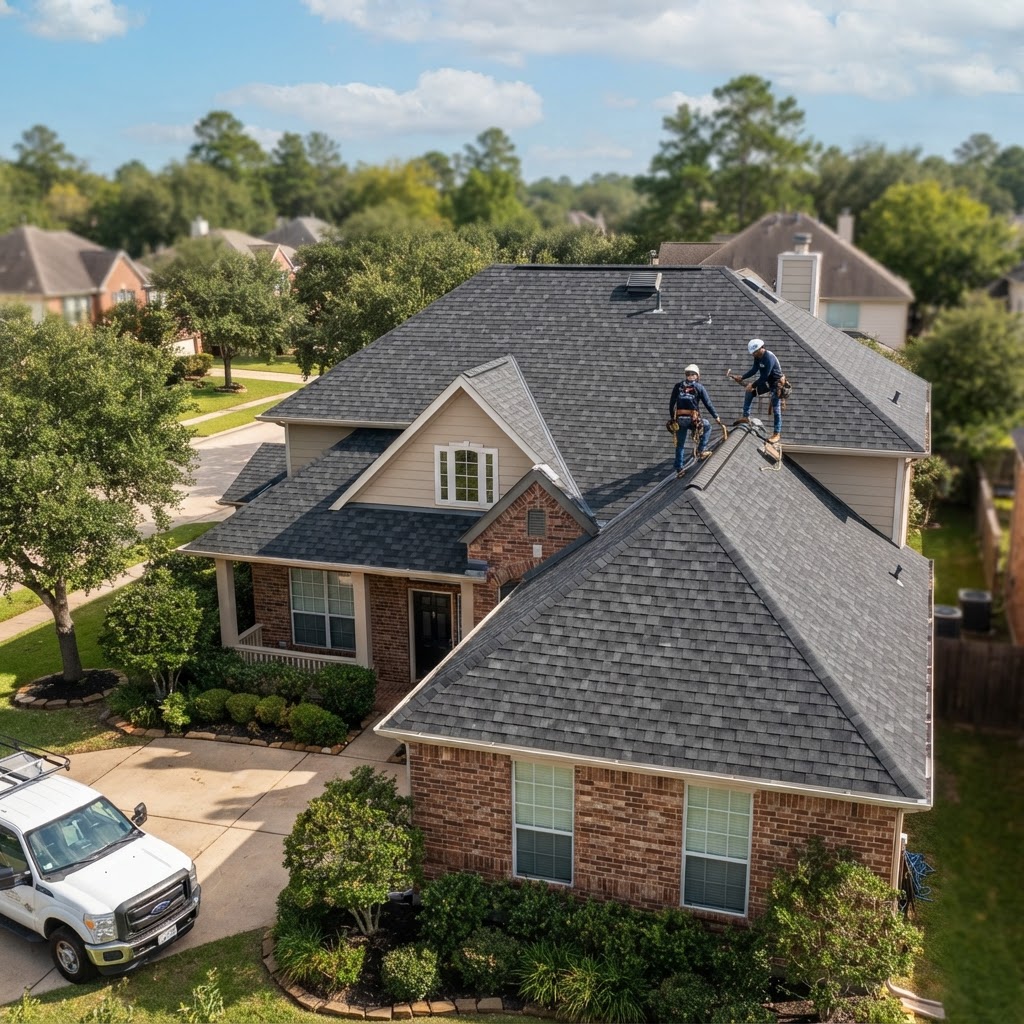
Why Your Tomball Roof Is Aging Faster Than It Should — And the 5-Step Fix Before Hurricane Season Ends
If your Tomball home's roof was installed more than 8 years ago, there's a good chance it's being quietly destroyed by a combination of UV degradation, attic heat buildup, and the kind of sudden hail that drops out of a clear Texas sky in June. Here's how to diagnose it yourself — and what to actually do about it.
If you've lived in Tomball for more than a few years, you already know the drill: a storm rolls in off the Gulf with almost no warning, drops golf-ball hail on your neighborhood specifically, and is gone before you can even get off the phone with your neighbor. Your roof takes the hit. Your insurance adjuster shows up two weeks later and tells you there's "no functional damage." And you're left wondering what just happened.
This post is for that homeowner. We're going to walk through why roofs in the Tomball area degrade faster than most manufacturer warranties account for, how to identify real damage versus surface wear, and what a proper remediation sequence looks like — before the back half of hurricane season (August through October) has its say.
Why Tomball Is Especially Hard on Roofing Systems
Tomball sits in a particularly punishing micro-climate. You're far enough inland to catch redirected Gulf moisture but still exposed to the full brunt of Texas UV radiation. That combination — relentless heat followed by sudden, violent precipitation — is a one-two punch most roofing systems aren't designed to absorb year after year.
Here's what's actually happening to your roof:
- UV granule bleed-off: Standard 3-tab and even mid-grade architectural shingles begin losing protective granules within 5–7 years in the Houston metro heat corridor. In Tomball, where summer attic temperatures can reach 160°F+, asphalt binder beneath those granules softens and becomes brittle in a cycle that accelerates aging by 30–40% compared to manufacturer lab conditions (which are modeled on Midwestern climates, not ours).
- Attic convection damage from below: This one surprises most homeowners. It's not just the sun cooking your shingles from the top — it's your attic cooking them from the bottom. Tomball homes with undersized ridge venting or blocked soffit vents trap superheated air that literally bakes the underside of your decking and weakens adhesive shingle strips, causing premature tab lifting.
- Foundation movement attacking your flashing: Harris County's expansive clay soils shift seasonally. That movement telegraphs up through your walls and manifests as micro-separations in step flashing around chimneys, skylights, and dormers — areas that then become entry points for the 55+ inches of annual rainfall Tomball averages.
- The "pop-up storm" hail problem: The spring hail season (March–May) gets all the press, but Tomball gets hit by isolated supercell activity well into July and August. These storms are fast-moving and hyperlocal — your house can take Class 3 hail while your neighbor two streets over sees nothing. If you didn't know it happened, your insurance claim window may already be closing.
Step 1: Do a Ground-Level Diagnostic Before You Climb Anything
Before you get on your roof (or hire anyone to), start from the ground and work inward.
Check your gutters first. After any significant storm, scoop out a handful of gutter debris. If you're pulling out dark, sandy granules in volume — not just a few — your shingles are actively shedding. That's a sign of either advanced UV wear or hail impact loosening granules.
Look at your siding and window screens. Hail that's big enough to damage shingles will dent aluminum window screens and leave spatter marks on painted wood or Hardie board siding. These are what public adjusters call "control surface" indicators — if your screens are dimpled, your roof almost certainly took functional damage.
Check your attic on a bright afternoon. Turn off the lights and look up. Any pinpoints of light coming through the decking boards mean you have compromised areas. Also check for dark staining on rafters or the underside of decking — that's moisture intrusion that's been happening long enough to show.
Step 2: Map the Damage Zones on Your Actual Roof
If your ground-level check raises flags, it's time to get eyes on the roof itself. If you're not comfortable on a pitched surface, skip directly to Step 3 — this part isn't worth a trip to the ER.
For those who do go up: you're looking for four specific things.
- Hail strikes — These look like small circular bruises or "soft spots" in the shingle surface where the mat beneath is fractured. They're often surrounded by a "halo" of missing granules. Don't confuse these with manufacturer blistering (which is round but raised) or foot traffic scuffs (which are linear).
- Lifted or cupped tabs — Run your hand flat across shingle surfaces. Any tabs that catch your hand or show daylight underneath have lost their adhesive bond. These are active leak pathways during wind-driven rain.
- Flashing separation — At every roof penetration (pipes, vents, chimneys, HVAC curbs), pull gently on the flashing. Any movement or visible gaps between flashing and roofing material is a problem.
- Ridge cap condition — Ridge caps take the highest UV exposure and wind uplift on the entire roof. If your ridge cap shingles are cracking or show significant granule loss, they're usually the first section to fail.
Step 3: Understand What Your Insurance Policy Actually Covers — Before You Call
This is where most Tomball homeowners leave money on the table.
Texas is an ACV (Actual Cash Value) vs. RCV (Replacement Cost Value) state — meaning what your policy pays depends entirely on your endorsements, not just the damage. If you have an ACV roof policy, your payout is depreciated based on the age of your roof. A 12-year-old roof with Class 3 hail damage might net you 40 cents on the dollar after depreciation.
Key things to know going into a claim:
- Texas law gives you one year from the date of the storm to file, not one year from when you discovered the damage. If you're not sure when your roof took a hit, pull storm data from the Storm Events Database (NOAA) or use a service like Verisk's Verifi hail mapping tool — your contractor should be able to pull this for you.
- State Farm, Allstate, and USAA all handle Texas hail claims differently. State Farm has moved aggressively to ACV endorsements on renewals since 2022. If you renewed your homeowners policy in the last two years and didn't specifically confirm your roof coverage, check your declarations page right now.
- A public adjuster is not always necessary — but a contractor who knows how to document functional damage (not just cosmetic) is essential. The difference between "granule loss" and "fractured mat with exposed fiberglass" in a claim report can mean $8,000–$15,000 on a standard Tomball ranch home.
Step 4: Choose the Right Replacement System for This Climate
If your roof needs replacement, product selection matters more than most contractors will tell you.
For Tomball specifically, we consistently recommend:
- GAF Timberline HDZ with StainGuard Plus: The HZ10 wind warranty is critical in our storm corridor. The LayerLock technology eliminates the lifted-tab problem entirely, and StainGuard Plus addresses the algae streaking that's endemic to high-humidity environments like ours. Street price installed runs $4.80–$6.20 per square foot depending on pitch and complexity.
- GAF WeatherWatch Ice & Water Barrier in valleys and eaves: Even in South Texas, freeze events happen — we saw it in February 2021 and again in January 2025. WeatherWatch in the first 3 feet of eave overhang protects against ice damming during those once-a-decade freeze events.
- Proper ridge vent sizing: Most re-roofs in Tomball are still being done with undersized ridge venting. You need a minimum of 1 square foot of net free area per 150 square feet of attic floor. Ask your contractor to show you the calculation before work starts.
Step 5: Nail the Post-Installation Inspection
The job isn't done when the crew leaves. Within 48 hours of completion:
- Walk the perimeter and look for leftover nails or debris in your gutters and downspout areas (missed nails are a liability and a puncture risk).
- Confirm your contractor has pulled a Harris County building permit — in Tomball city limits, a permit is required for full replacements. No permit means no final inspection, which can create title problems when you sell.
- Request your GAF warranty registration confirmation. For GAF Master Elite® contractors, the Golden Pledge® warranty covers both materials and workmanship up to 25 years. Make sure you receive the actual registration number, not just a promise it was submitted.
The Honest Bottom Line
Most Tomball homeowners are walking around with roofs that are functionally 2–4 years older than their age suggests, because the manufacturer's warranty was written for a climate that isn't ours. The good news is that a thorough inspection — done before the August–October storm peak — gives you options. You can document existing damage before new storms complicate your claim, you can address small flashing issues before they become interior water damage, and you can make an informed replacement decision rather than a panicked one.
If you've done the ground-level checks above and you're seeing red flags, the smartest next step is a no-pressure professional inspection from a contractor who will give you a written report — not just a verbal assessment and a sales pitch. At FairClaims Roofing & Construction, that inspection includes a hail mapping report, photographic damage documentation, and a straight answer about whether your roof needs repair, replacement, or neither.
Request your inspection before August 15th and we'll have your written report turned around within 5 business days — before the statistical peak of Gulf storm season hits the Houston metro.
Need a roof inspection?
FairClaims Roofing & Construction offers free inspections across the Texas Triangle.
Click to Call