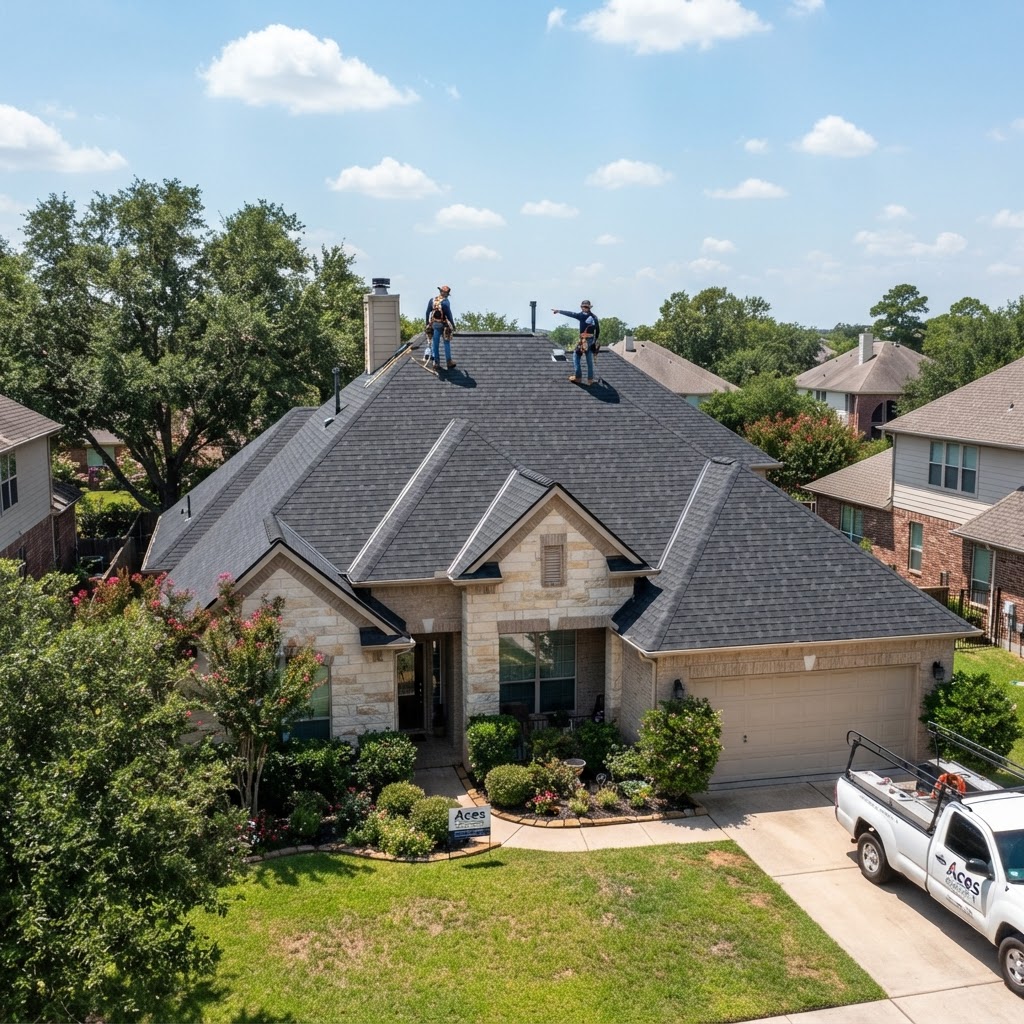
Tomball Homeowner's Seasonal Roof Checklist: What to Do Before, During, and After Texas Storm Season
Most Tomball homeowners don't think about their roof until water appears on the ceiling. Here's a season-by-season checklist — with things you can actually do yourself — to stay ahead of Texas storms, hail, and the brutal UV punishment that quietly destroys shingles before any storm ever hits.
If you've lived in Tomball for more than one spring, you already know the drill. A perfectly clear morning turns into a sky the color of a bruise by 2 PM, and by 3 PM your yard looks like a slushie machine exploded. Northwest Harris County sits in one of the most active hail corridors in the United States — the so-called "Hail Alley" spur that dips down from Oklahoma through the DFW Metroplex and catches Houston's northern suburbs with alarming regularity.
But here's what most homeowners don't realize: the hail isn't always what kills your roof first. It's the 180°F attic temperatures in July, the foundation movement that quietly separates your step flashing from the chimney, and the algae that sets up shop on north-facing slopes thanks to Tomball's persistent humidity. By the time a storm rolls through, your roof may already be compromised — and that's when a $4,000 repair becomes a $14,000 replacement.
This checklist is organized by season because Texas doesn't follow a single "storm season." We have at least three distinct threat windows every year.
February–March: Pre-Spring Hail Season Prep
Texas hail season typically runs March through June, but some of the nastiest storms arrive in late February when cold fronts from the Panhandle collide with Gulf moisture. The February 2021 freeze — Winter Storm Uri — was a different kind of disaster, but it exposed something important: ice damming and thermal shock cracking in shingles that then failed catastrophically during the spring hail events that followed.
What you can do yourself:
- Walk your attic with a flashlight after any freeze event. You're looking for daylight pinholes, dark staining on the decking (a sign of moisture intrusion), and soft spots. Press gently on the OSB decking — it shouldn't feel spongy.
- Check your attic ventilation. Tomball homes frequently have ridge vents packed with blown-in insulation that migrated over the winter. Blocked ventilation means heat builds up faster in summer and ice damming is worse in freeze events. You can clear intake vents from the attic side without getting on the roof.
- Document your roof with photos. Before storm season, take dated photos of every slope from the ground using a zoom lens. This is your baseline for insurance claims. If a hailstorm hits and your adjuster argues damage is "pre-existing," those photos are your counter-argument.
- Clean your gutters completely. After oak and pine debris from winter, Tomball gutters are typically packed by February. Clogged gutters cause fascia rot and water backup under the drip edge — a sneaky entry point that looks like a roof leak but is technically a gutter/fascia failure.
April–June: Active Hail and Severe Storm Season
This is the window where Tomball gets hit hardest. The April 2016 hailstorm caused over $1.5 billion in insured losses across the Greater Houston area. More recently, the May 2024 derecho that tracked through Montgomery and Harris Counties produced straight-line winds exceeding 80 mph and golf-ball hail in parts of Spring and Tomball.
After any storm producing hail larger than a dime:
- Check your HVAC condenser fins first. Seriously — before you get on the roof. If your condenser fins are dented, your roof took a hit. This is a quick ground-level indicator that saves you a trip up a ladder before you even know if you have a claim.
- Inspect soft metals from the ground or a ladder at the eave. Look at your aluminum gutters, downspout elbows, and any painted metal vents. Hail leaves circular dents ("spatter marks") on soft metals that are easy to photograph and nearly impossible for an insurance adjuster to dispute.
- Check window screens and wood trim. Hail impact leaves circular marks on painted wood trim. These are supplemental claim items that many homeowners miss — and insurers aren't going to point them out for you.
- Do NOT walk your roof after a hailstorm. This sounds counterintuitive, but walking on hail-damaged shingles accelerates granule loss and can actually void certain manufacturer warranties by causing additional damage. Let a licensed professional do the slope inspection.
The insurance call timing insight most homeowners don't know: In Texas, you have two years from the date of loss to file a hail claim under most policies (check your specific policy — this changed with 2019 Texas legislation). Don't let a pushy public adjuster or contractor pressure you into filing the same week as the storm if you're not ready. But also don't wait until you see interior leaking — by then you may have a "neglect" argument working against you.
July–September: Heat, UV, and Hurricane Season
This is the quiet killer window. No dramatic storms, just relentless punishment. Tomball's combination of 95°F+ ambient temperatures and extreme UV index means roof surface temperatures on dark shingles regularly exceed 160–180°F. That heat accelerates asphalt volatilization — the oils that keep shingles flexible literally cook off over time, leaving brittle shingles that crack under the first significant hail impact of the following spring.
What to do in this window:
- Check your attic temperature on a hot afternoon. A properly ventilated attic should run roughly 10–15°F above ambient. If your attic is hitting 150°F+ when it's 95°F outside, you have a ventilation problem. GAF Cobra ridge vent products or additional soffit venting can make a dramatic difference — and extend shingle life by 3–5 years.
- Look for granule accumulation in your gutters. A handful of granules after a heavy rain is normal. A coffee-can worth of granules means your shingles are aging out. If you have an older GAF Timberline or CertainTeed Landmark roof, this is your early warning.
- Hurricane prep (August–October): For named storms, the primary risk in Tomball isn't storm surge — it's sustained 50–70 mph winds with embedded tornadoes. Check that any recently installed pipe boots (the rubber collar around plumbing vents) haven't cracked. UV-degraded pipe boots are the #1 source of roof leaks we see after tropical events — the wind didn't damage the shingle, but the old boot finally failed under wind-driven rain.
October–November: Post-Storm Season Inspection Window
October is genuinely the best month to get on your roof in Texas. Temperatures are reasonable, storm risk is lower, and you have time to make repairs before any winter freeze events.
Year-end checklist:
- Inspect all flashing. Tomball sits on expansive clay soils — the same foundation movement that causes slab cracking also moves the masonry your step flashing is attached to. Look at chimney flashing, sidewall flashing, and any skylights for separations or lifted edges. Lap caulk (NOT roofing tar) is a temporary fix; proper re-flashing requires a professional.
- Trim tree limbs within 10 feet of the roof. Pine trees in Tomball drop limbs in ice events. A limb doesn't have to puncture your roof to cause damage — repeated contact abrades granules off shingles over time.
- Check ridge cap shingles specifically. Ridge caps take more UV and wind exposure than field shingles. On a 15–20 year old roof, ridge caps often fail 3–5 years before the field shingles. Curling or missing ridge caps are both an insurance claim opportunity and a water intrusion risk.
One Thing That Will Surprise You
Most homeowners assume their roof inspection after a storm is primarily about the shingles. In our experience across thousands of Harris and Montgomery County roofs, the shingles are rarely where the water actually enters. It's the penetrations — pipe boots, vents, chimneys, skylights — that fail first. We've seen brand-new GAF Timberline HDZ shingles (excellent product, warranted to 130 mph wind) on a roof where three pipe boots were cracked open like dried fruit. The shingles were perfect. The attic had active mold. Always inspect the penetrations first.
Your Next Step
If you've gone through this checklist and found soft attic decking, missing ridge caps, cracked pipe boots, or significant granule loss in your gutters, it's worth getting a professional set of eyes before next spring's hail season opens. FairClaims Roofing & Construction offers free roof assessments for Tomball homeowners — no obligation, no pressure to file a claim. We'll tell you honestly what we find and what it means for your roof's remaining lifespan.
Schedule yours at fairclaimsroofing.com or call us directly. Bring your dated photos from February — you'll be glad you took them.
Need a roof inspection?
FairClaims Roofing & Construction offers free inspections across the Texas Triangle.
Click to Call