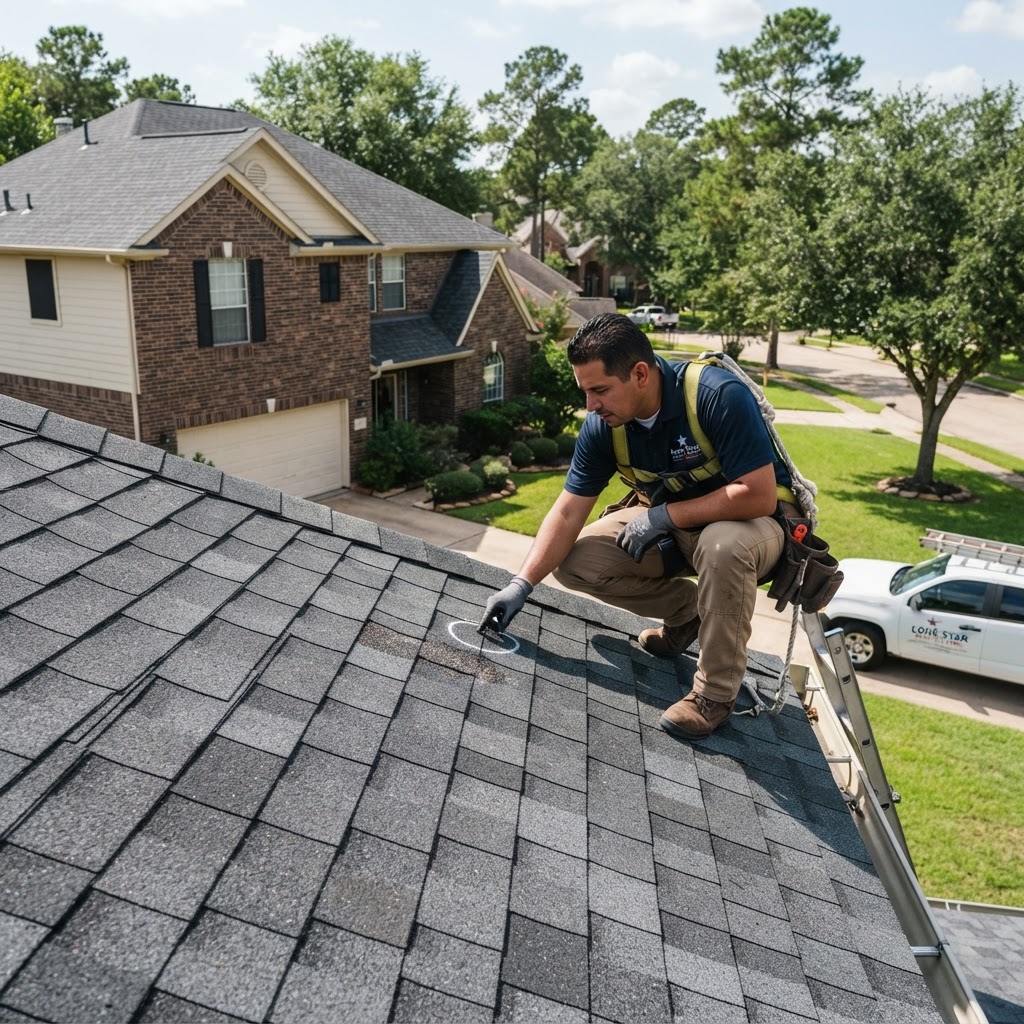
The 'Storm Chaser Said I Have Damage' Myth: Why Most Spring, TX Homeowners Are Getting Bad Insurance Advice After Hail
After every hail storm in Spring, TX, a parade of out-of-state contractors floods the neighborhood telling homeowners their roof is totaled. Here's what's actually true — and what it costs you when you believe the wrong person.
Every spring and early summer, the skies over Spring, TX do exactly what they've always done: they build. A warm Gulf moisture feed collides with a dry line pushing east off the Hill Country, and by 3:00 p.m. you've got a pop-up supercell dropping 1.5-inch hail on Gleannloch Farms while the sun is still shining in The Woodlands. Within 48 hours, trucks with out-of-state plates are crawling every cul-de-sac, and homeowners are being handed clipboards and told their roof is "a total loss."
This is the most damaging myth in residential roofing today — and it costs Spring homeowners real money.
The Myth: "If a Contractor Says You Have Damage, You Probably Do"
The truth is more complicated, and understanding it can save you thousands of dollars in deductibles, inflated claims, and coverage non-renewals.
Post-storm contractors — often called storm chasers — operate on a simple business model: identify ZIP codes hit by hail, knock on doors, and get homeowners to sign an Assignment of Benefits (AOB) or a contingency contract before a licensed local contractor or the insurance adjuster ever gets on the roof. Their incentive is to find damage, whether it's there or not.
Here's what they rarely tell you:
- Not all hail causes actionable insurance damage. A storm that drops 3/4-inch hail may leave cosmetic dings in aluminum flashing and soft-metal vents while leaving your GAF Timberline HDZ shingles functionally intact. Insurance policies cover functional damage — meaning damage that compromises the roof's ability to shed water and protect the structure. Cosmetic damage is explicitly excluded in most Texas homeowner policies under language added by TDI guidance around 2013.
- Harris County hail mapping isn't proof of your claim. Storm chasers often show you a hail map from a service like Verisk or CoreLogic showing your address inside a hail swath. That's a starting point, not a verdict. The actual stone size at your specific address, the roof pitch, the age of your shingles, and the impact angle all matter enormously.
- Filing a claim you can't support costs you. In Texas, insurers can non-renew your policy after as few as two claims in three years, regardless of whether those claims were paid. That's not a rumor — it's standard practice at carriers like State Farm, Allstate, and USAA operating in the Texas market.
What Real Hail Damage Looks Like on a Texas Roof
After inspecting roofs across Harris, Montgomery, and Fort Bend counties through hail events like the April 2021 outbreak (which produced 2.75-inch stones in Cypress and Spring), here's what legitimate functional damage actually looks like:
- Granule displacement with exposed fiberglass mat. On asphalt shingles, a direct hail hit removes the protective granule layer and leaves the gray fiberglass mat visible. This isn't just a bruise — it's an opening for UV degradation, and in a Texas summer, that progression is fast. Our UV index readings here regularly exceed 10 from May through September.
- Cracked or split shingles at the impact point. Larger stones (1.5 inches and above) can fracture the shingle body entirely. These are legitimate functional failures.
- Dented or cracked ridge caps. Ridge caps take the most direct hits and are often the first place to show real damage.
- Soft-metal confirmation hits. If you have dings on your gutters, drip edge, and HVAC flashing caps that are consistent in size and pattern, that corroborates your shingle claim. Random denting patterns suggest old damage or debris, not a single storm event.
What it does not look like: surface scuffs from roof traffic, oxidation staining mistaken for granule loss, or the natural micro-cracking that develops in older shingles from Texas thermal cycling (we routinely see surface temps above 165°F on dark shingles in July).
The Insight That Surprises Most Homeowners
Here's something that rarely comes up in those driveway conversations with storm chasers: the age and condition of your roof before the storm is legally relevant to your claim.
Texas insurers have increasingly moved to Actual Cash Value (ACV) policies or have added cosmetic damage exclusion riders. Under ACV, if your 14-year-old 3-tab shingle roof gets hit by hail, the insurance company calculates depreciation and pays you the current value of that roof — not what it costs to replace it. You pay the difference. A storm chaser who signs you up for a full replacement claim on an ACV policy isn't doing you a favor. They're setting you up for a fight you'll probably lose, or a settlement that leaves you writing a large check you didn't expect.
If your policy was written or renewed after 2018 and you haven't read the cosmetic damage exclusion language, do it today.
What You Should Actually Do After a Hail Storm in Spring, TX
Step 1: Wait 24–48 hours. Let the initial chaos clear. Document the storm date, check your local NWS Houston radar archive, and photograph your property from the ground immediately after — before any contractor touches your roof.
Step 2: Call a licensed, local Texas contractor first. Verify their RCAT license number on the Texas Department of Licensing and Regulation (TDLR) database before they set foot on your property. An unlicensed contractor cannot legally perform roofing work in Texas on jobs over $10,000.
Step 3: Get an honest inspection — not a sales pitch. A legitimate inspector will tell you if you have no claim-worthy damage. That answer should be possible. If every contractor who walks your roof says you need a full replacement, that's a red flag, not reassurance.
Step 4: Be present for the insurance adjuster. You have the right to have your contractor on the roof at the same time as the adjuster. Take advantage of it. A knowledgeable contractor can point out legitimate damage the adjuster might miss — and push back on false positives the storm chaser may have flagged.
Step 5: Understand what you're signing. Never sign an Assignment of Benefits before your insurance company has issued a decision. AOB documents transfer your claim rights to the contractor, not you. Texas has reformed AOB law, but contingency contracts can still bind you in ways that limit your options.
The Bottom Line
Spring, TX gets hit hard. We had three significant hail events in Harris and Montgomery counties between March and June of 2025 alone, and the 2026 season is already trending active. Real damage happens — and when it does, you deserve a full, honest claim.
But the worst thing you can do after a storm is hand your roof and your insurance policy over to someone who drove in from Oklahoma and will be gone before the first rain hits your repaired roof.
If you want a straight answer about what's actually on your roof, the team at FairClaims Roofing & Construction has been inspecting storm damage in the Spring and Greater Houston area for over 20 years. We'll tell you what's there — and what isn't.
Not sure if your roof has real damage from a recent storm? Schedule a no-pressure inspection and get a written assessment you can actually use — whether you file a claim or not.
Need a roof inspection?
FairClaims Roofing & Construction offers free inspections across the Texas Triangle.
Click to Call