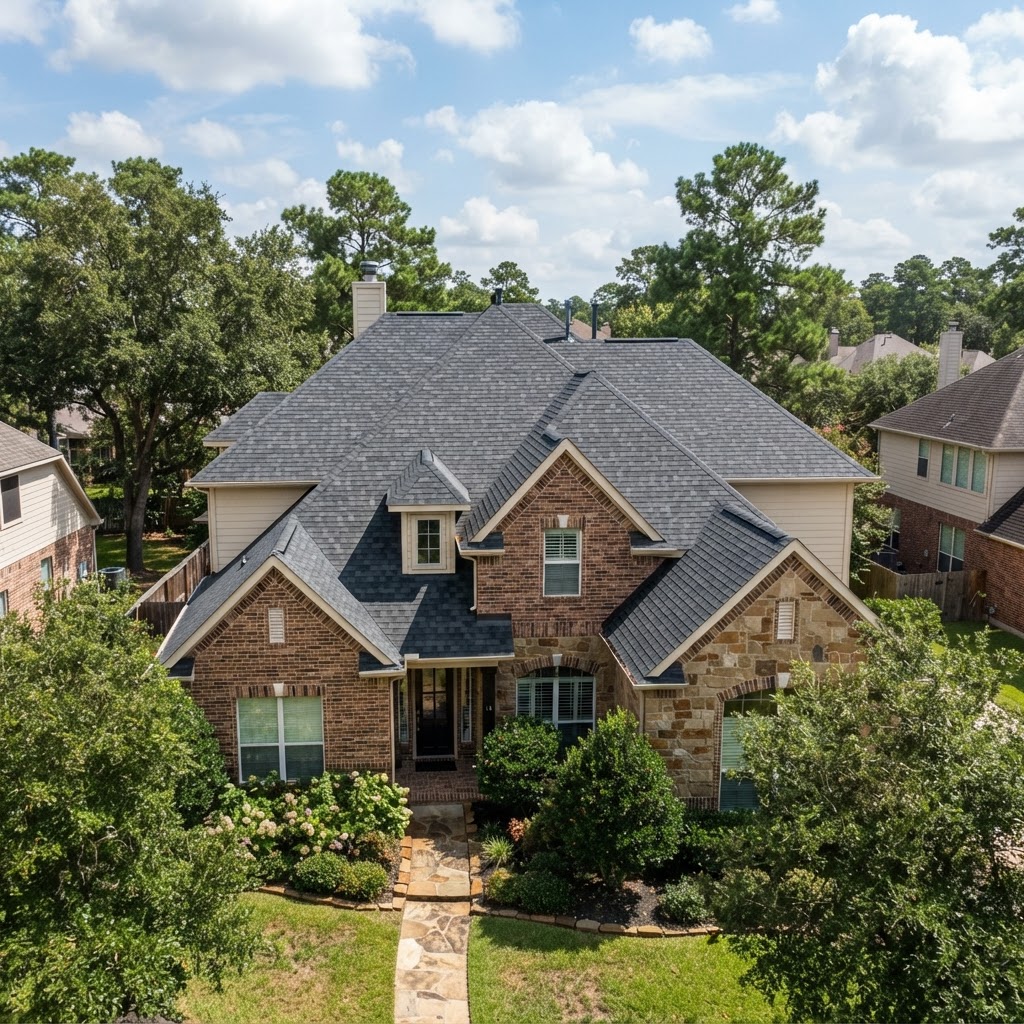
The 'New Roof = Denied Claim' Myth Is Costing The Woodlands Homeowners Thousands
Contractors and neighbors keep saying it: 'Your roof is only 3 years old — your insurance won't pay out.' It sounds logical. It's also dead wrong. Here's what Texas insurance adjusters actually look at, and how to protect yourself when the next Montgomery County hailstorm rolls through.
There's a piece of roofing folklore that circulates endlessly in HOA Facebook groups from Creekside Park to Sterling Ridge: if your roof is relatively new, your insurance company won't cover hail damage because they'll assume it 'should have held up.' Homeowners repeat this to each other with total confidence. Some even skip filing claims because of it.
After 20+ years on roofs across the Texas Triangle — from The Woodlands to Cypress to Conroe — we've seen exactly how much money this myth costs people. Let's dismantle it with facts.
The Myth, Stated Plainly
"My roof is only four years old, so my insurance company will deny my hail claim. No point in calling anyone."
Versions of this show up everywhere. Sometimes it's framed as "they'll say it's wear and tear." Sometimes it's "the adjuster will just lowball you because the roof isn't old enough to replace." Occasionally a well-meaning neighbor adds: "I heard State Farm won't pay on anything under five years old."
None of these are rooted in actual Texas insurance law or claims practice.
What Insurance Adjusters Actually Look For
Hail damage claims are evaluated on causation and severity — not roof age. Here's the real framework:
Texas Department of Insurance guidelines require carriers to assess whether a covered peril (hail, wind) caused the damage. A three-year-old GAF Timberline HDZ roof that took a direct hit from 1.5" hailstones during a pop-up storm in April is storm-damaged, full stop. The shingle's age doesn't magically create an exclusion.
What adjusters do evaluate:
- Bruising patterns on shingles — hail hits leave a distinctive fractured mat underneath the granule surface; this doesn't look like aging
- Dent consistency — a legitimate hail event produces damage in a consistent directional pattern across the roof plane, gutters, AC condenser fins, and window screens
- Impact density — adjusters count hits per 10-square-foot test square; most carriers require a minimum threshold (often 6–8 hits per square) before authorizing full replacement
- Collateral damage — bent gutter guards, pocked fascia, and dented flashing corroborate the storm event regardless of shingle age
A new roof can fail these tests just as readily as a 15-year-old one — and pass them just as readily too.
The Real Wrinkle: Actual Cash Value vs. Replacement Cost Value
Here's where roof age does matter — and most homeowners don't understand this distinction until they're staring at a check that's $4,000 short.
Many Texas homeowners, particularly those in The Woodlands communities built in the 2000s and 2010s, are unknowingly carrying Actual Cash Value (ACV) policies or endorsements on their roofs. Under ACV, your carrier depreciates the roof before paying out.
Example: You have a 7-year-old 3-tab roof (average lifespan ~20 years). After a confirmed hail event, replacement costs $18,000. Under ACV, your carrier calculates the roof is roughly 35% through its lifespan — so they depreciate the claim by 35%, handing you a check for ~$11,700 before your deductible. That gap isn't because they disputed the damage. That's the policy structure.
Under a Replacement Cost Value (RCV) policy, you receive the initial ACV payment, complete the repairs, then submit for the recoverable depreciation — bringing your total payout much closer to the actual replacement cost.
This is the conversation to have with your insurance agent before storm season, not after. Review your Declarations Page for the words "ACV" or "Limited Roof Payment" before the next Montgomery County hailstorm shows up on radar.
Why The Woodlands Is Particularly Vulnerable to This Confusion
Montgomery County sits in one of the most active hail corridors in North America. The area routinely sees severe hail events in March through May and again in September and October — and increasingly, pop-up supercells in what used to be the "quiet" summer months.
The April 2021 storm system that tracked through The Woodlands produced verified 1.75" hailstones in parts of Creekside Park and Indian Springs. The February 2021 freeze event (Winter Storm Uri) caused a different but equally serious problem: thermal shock to shingles combined with ice dam formation along the eaves, which cracked sealant strips on newer installations.
Both events generated legitimate insurance claims on roofs that were 2–5 years old. Both event types are covered perils. The age of the roof was irrelevant to claim eligibility.
What did affect outcomes? Documentation. Homeowners who had dated photos of their pre-storm roof condition, who filed promptly within their carrier's claim window (typically one year in Texas, though policy language varies), and who had a qualified contractor present during the adjuster's inspection consistently received fairer settlements.
The Surprising Thing Most Homeowners Don't Know About Adjuster Inspections
Here's something that genuinely surprises people: you are allowed — and often wise — to have your own roofing contractor on the roof at the same time as the insurance adjuster.
Adjusters, especially third-party catastrophe adjusters brought in after major storm events, are often working 15–20 inspections per day across multiple counties. They are not adversaries, but they are moving fast. A qualified contractor who knows what functional damage looks like (not just cosmetic granule loss, but actual mat fracture and compromised waterproofing integrity) can point out missed hits, document areas the adjuster didn't fully inspect, and ask for a re-inspection or supplemental review if the initial scope is incomplete.
This is standard practice in the industry. Carriers like Allstate, State Farm, USAA, and Farmers all have processes for contractor-assisted reinspections and supplement requests. It's not confrontational — it's how the process is designed to work.
What Legitimately Can Reduce or Deny Your Claim
To be fair to the insurance companies, here are real reasons a hail claim gets reduced or denied — none of which are roof age:
- Pre-existing damage that predates the storm event — this is why condition documentation matters before storm season
- Maintenance neglect — missing shingles, open flashing, or failed pipe boot seals that existed before the event
- Late filing — Texas policies typically require you to file within one year of the date of loss (some are shorter; read your policy)
- No verifiable storm event — if weather data doesn't confirm hail at your specific address, carriers will push back; NOAA storm reports and insurance company weather verification tools (like Verisk's Xactware platform) are used to cross-reference claims
- Cosmetic damage only — granule loss that doesn't compromise the waterproofing layer may not meet the threshold for replacement under some policies
The Bottom Line for Woodlands Homeowners
If you've had a storm roll through your neighborhood — even if your roof looks fine from the street — a professional inspection is worth scheduling. Hail damage is often invisible from the ground and doesn't always cause immediate leaks. It degrades the UV-protective granule layer, accelerates shingle aging in our brutal Texas summers, and can void manufacturer warranties if left undocumented.
At FairClaims Roofing & Construction, we offer no-obligation post-storm inspections for homeowners in The Woodlands and surrounding communities. As a GAF Master Elite® contractor, we're trained to identify functional storm damage — not just surface wear — and we can walk you through what your policy language actually means before you make any decisions.
Your next step: Pull out your homeowner's insurance Declarations Page and look for the words "Actual Cash Value," "Limited Roof Payment Schedule," or "Cosmetic Damage Exclusion" in the roof section. If you see any of them, call your agent and ask specifically what you're giving up. That one conversation — before the next storm — could save you $5,000 to $10,000 when it counts.
Need a roof inspection?
FairClaims Roofing & Construction offers free inspections across the Texas Triangle.
Click to Call