The Myth That Your Insurance Company Determines Roof Damage — And Why That Belief Costs Texas Homeowners Thousands
Most homeowners in The Woodlands assume the insurance adjuster has the final word on roof damage. Here's what 20+ years on Texas roofs taught us: that assumption is one of the most expensive mistakes you can make after a storm.
After the April 2024 hail storms tore through Montgomery County — dropping golf ball-sized hail across The Woodlands, Spring, and Tomball — our crews were on rooftops within 48 hours. What we kept hearing from homeowners was some version of the same thing: "The adjuster came out and said there wasn't enough damage. I guess we're fine."
Some of those same roofs had 60, 80, even 120 impact marks per square. They were not fine.
This is the myth we need to dismantle: the insurance adjuster's initial assessment is not the final word, and it is not always accurate. Understanding why — and what to do about it — can be the difference between a fully covered replacement and paying $18,000 to $28,000 out of pocket for a new roof in the Greater Houston area.
Why Adjusters Miss Damage More Often Than You'd Think
Insurance adjusters are not roofing contractors. Many are catastrophe (CAT) adjusters flown in from out of state after a major weather event — they may have spent the previous month in Florida assessing hurricane damage and have limited familiarity with the specific hail patterns and shingle behavior common to North Houston suburbs.
Here's something that surprises most homeowners: hail damage to asphalt shingles is not always visible from the ground, and sometimes barely visible from the roof itself on the day of the storm. The real evidence shows up in a few specific ways:
- Bruising beneath the granule surface — Press your thumb into an impact point on an older GAF Timberline HDZ or Owens Corning Duration shingle and you'll feel a soft, spongy give where the asphalt mat has been fractured. Adjusters using a 30-second walk across the ridge often miss this entirely.
- Granule displacement patterns — Random granule loss from normal weathering looks different from the circular, starburst-pattern loss caused by hail. An experienced eye spots this immediately. A rushed adjuster sometimes does not.
- Functional damage vs. cosmetic damage — Texas insurance policies (and Texas case law) draw a distinction here. Cosmetic damage affects appearance; functional damage compromises the shingle's ability to shed water and protect against future weather. Insurers have increasingly tried to classify hail hits as "cosmetic" to avoid paying claims, particularly after the Texas legislature passed HB 2102 in 2023, which allowed carriers to add cosmetic damage exclusions to policies with homeowner consent. Check your policy right now — if you signed a cosmetic damage exclusion rider, your claim options changed significantly.
The Texas Weather Reality That Changes the Equation
The Woodlands sits in one of the most hail-active corridors in the United States. Montgomery County averages multiple significant hail events per year, with the April–June window being the highest-risk period. But unlike flat-out catastrophic events that trigger automatic insurance response, many of the worst storms here are pop-up supercells that drop large hail in a tight geographic band — sometimes just a few neighborhoods wide.
That localized pattern creates a documentation problem. If the official weather station data shows 1-inch hail but your roof took 2-inch stones because you were directly under the storm's core, the adjuster may use that weather data to understate your claim. This is why storm path data from services like Verisk's Veritas or CoreLogic's weather analytics — which your public adjuster or roofing contractor can pull — matters enormously.
On top of hail, The Woodlands has its own compounding factors that accelerate damage after an impact event:
- Extreme UV exposure — South-facing slopes in our climate degrade shingles 30–40% faster than north-facing ones. A shingle already stressed by UV becomes far more vulnerable when impacted.
- Humidity-driven attic moisture — When hail compromises flashing seals around pipe boots and ridge caps, our 85%+ summer humidity finds its way in fast. What starts as a minor penetration becomes a decking issue within 18 months.
- Foundation movement affecting step flashing — The expansive clay soils throughout Montgomery County cause subtle seasonal foundation shifts. That movement stresses the step flashing along dormers and chimneys — areas already vulnerable after hail loosens sealant bonds.
By the time a homeowner notices a ceiling stain, the damage chain often started at an impact point an adjuster dismissed two years earlier.
What You're Actually Entitled to Do
Texas law gives you more leverage than most homeowners realize. Here's the process that works:
-
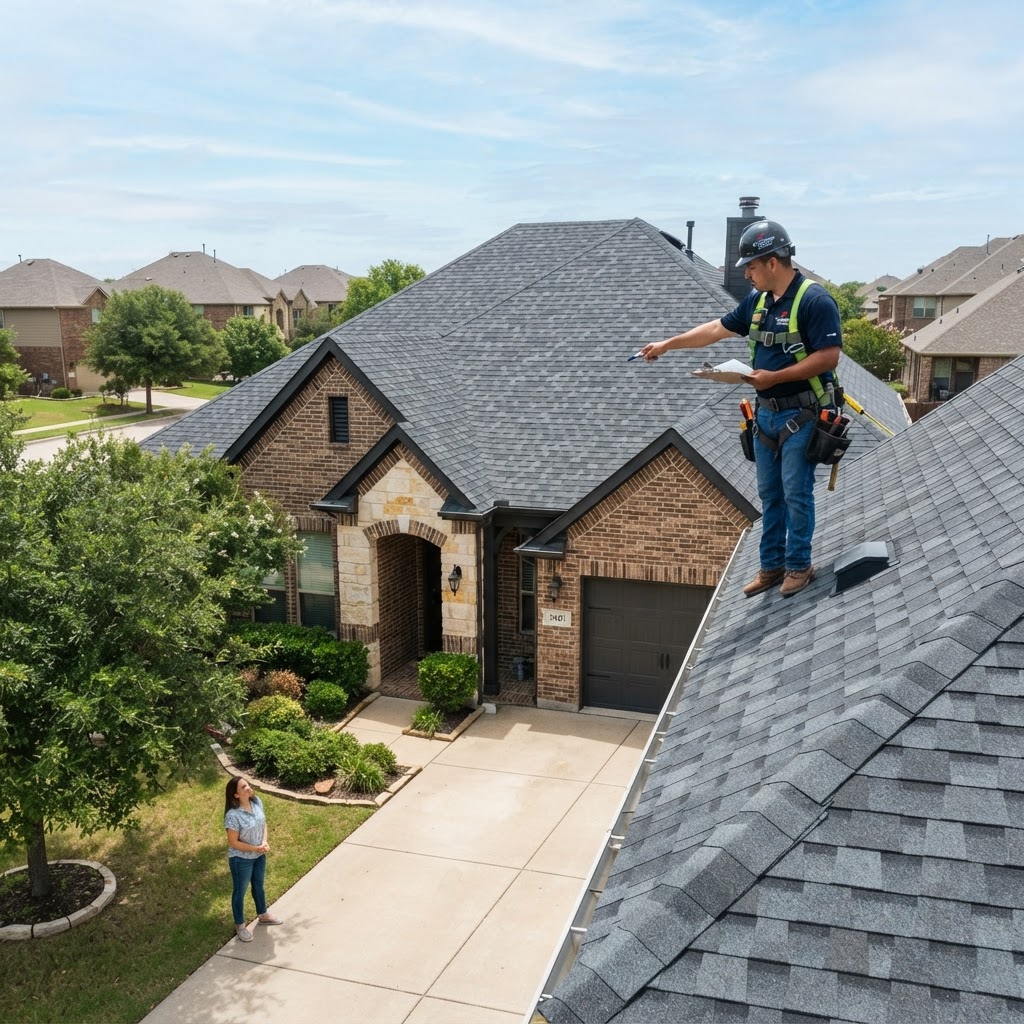
Get an independent inspection before you accept or deny a claim. You are not obligated to accept the first adjuster's assessment. A licensed roofing contractor — not a storm chaser from out of state who showed up at your door — can document damage with photos, measurements, and impact counts per square.
-
Request a re-inspection with your contractor present. Under the Texas Insurance Code, you have the right to dispute a claim decision. Having a contractor on the roof simultaneously with the adjuster changes the dynamic entirely. Points get discussed in real time rather than in a PDF denial letter.
-
Invoke the appraisal clause if necessary. Most Texas homeowner policies include an appraisal process where each side selects a competent appraiser and they agree on an umpire. This is a faster, cheaper alternative to litigation and frequently results in significantly higher settlements than the original offer. Many homeowners don't know this clause exists.
-
Document everything with dates. Texas law (Chapter 542 of the Insurance Code) requires insurers to acknowledge your claim within 15 days and accept or reject it within 15 business days of receiving all requested items. Carriers that miss these deadlines may owe you interest and attorney fees. Keep records.
The One Number That Changes How You Think About This
Industry data consistently shows that homeowners who have a professional contractor present during the insurance inspection receive settlements averaging 40–60% higher than those who go through the process alone. That's not a small rounding error — on a $22,000 roof replacement in The Woodlands, that gap is $8,800 to $13,200.
The adjuster isn't necessarily acting in bad faith. They're often overworked, working from a proprietary estimating platform like Xactimate with preset pricing that frequently runs below actual contractor costs in the Houston market, and they're on your roof for 20 minutes. A contractor who has inspected hundreds of post-storm roofs in this specific zip code is going to see things differently.
At FairClaims Roofing & Construction, we've been through this process with homeowners across The Woodlands, Conroe, Magnolia, and Kingwood enough times to know exactly where the documentation gaps tend to appear — and how to close them before a claim gets undervalued.
The Bottom Line
The insurance adjuster's report is a starting point, not a verdict. Texas law, your policy's appraisal clause, and the right professional support all exist to make sure you're treated fairly — but only if you use them.
If you had hail in the last 18 months and haven't had an independent inspection, that's the single most useful next step you can take. A thorough inspection costs you nothing and takes about 45 minutes. The information you get from it might be worth far more than that.
Schedule a no-obligation roof inspection with a licensed, locally-based contractor who knows Montgomery County roofs — and make sure they'll be willing to be present if you need a re-inspection with your adjuster.
Need a roof inspection?
FairClaims Roofing & Construction offers free inspections across the Texas Triangle.
Click to Call