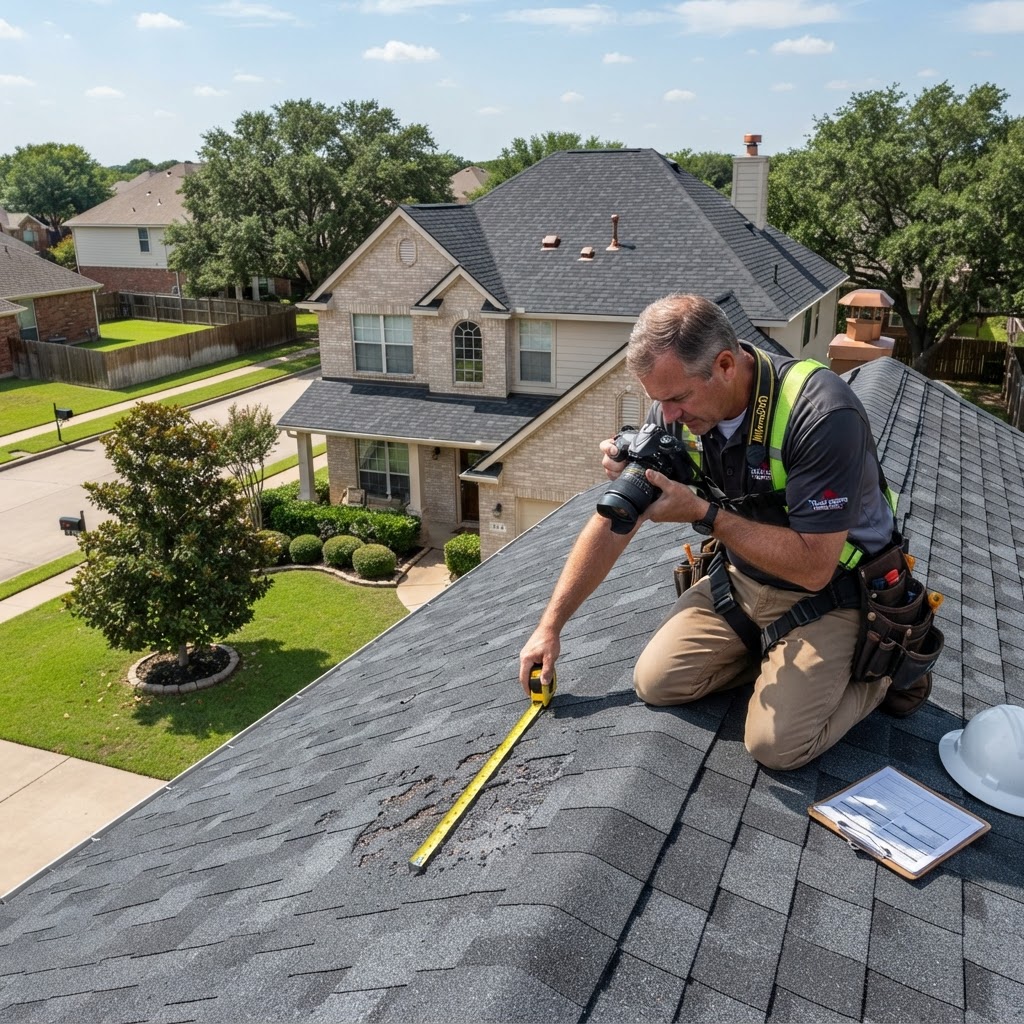
The Magnolia Homeowner's Roofing Insurance Claim Playbook: How to Document Storm Damage and Avoid Getting Underpaid
After a hail storm rolls through Montgomery County, most homeowners don't know what adjusters are actually looking for — or how easy it is to leave thousands of dollars on the table. Here's what 20+ years on Texas roofs has taught us about fighting for a fair payout.
If you live in Magnolia, you already know the drill. A pop-up storm rolls in off the Gulf corridor between April and June, drops golf ball-sized hail for eleven minutes, and disappears before you've even muted the TV. By the next morning, your neighbor has three roofing company door hangers on their porch and a voicemail from their insurance agent.
What happens in the next 72 hours — and specifically, what you document and how — will determine whether your claim gets paid in full, gets lowballed, or gets denied entirely.
This guide is written for homeowners in Magnolia and the broader Montgomery County area. The insurance game is not the same in Texas as it is in Ohio. Our storms are more severe, our UV exposure is more aggressive, and our insurers have more experience finding reasons to underpay. Let's level the playing field.
Understand What You're Actually Filing For
Most homeowners assume a hail claim is simple: hail falls, roof gets damaged, insurance pays to replace it. The reality is more layered. Texas insurers — particularly Allstate, State Farm, and USAA, which dominate Montgomery County policies — have spent years training their adjusters to distinguish between functional damage and cosmetic damage.
Functional damage means the impact has compromised the roof's ability to shed water: fractured fiberglass mats in shingles, displaced granules exposing the asphalt substrate, dented ridge caps, or cracked field shingles. This is what triggers a full replacement claim.
Cosmetic damage — surface scuffs, minor dents in aluminum flashings, aesthetic marks — can often be excluded under newer Texas policy riders, sometimes called Cosmetic Damage Exclusions or ACV (Actual Cash Value) endorsements. If your policy includes one and you haven't read it, do it today. Many Magnolia homeowners were blindsided by these riders after Winter Storm Uri in February 2021 and the spring hail events of 2023.
Document Before Anyone Else Gets on Your Roof
This is the single most important thing you can do, and almost nobody does it correctly.
The moment you suspect storm damage — even before you call your insurer — take the following steps:
-
Photograph the storm event itself. Screenshot your weather app showing date, time, and hail size. Apps like Weather Underground or the National Weather Service archive local hail reports; download a copy. Insurance companies use third-party weather verification services (CoreLogic Hazard HQ is a common one), and having your own records prevents disputes about whether hail actually occurred at your address.
-
Photograph your gutters and downspout splash blocks. This is a trick most homeowners don't know: hail impact leaves a distinctive "spatter" pattern in the dirt or mulch around your downspouts. Granule loss from shingles also accumulates visibly in gutters after a storm. A gutter full of granules is one of the clearest indicators of legitimate damage — and it disappears after the next rain.
-
Photograph every soft metal surface you can safely reach from the ground. AC condenser fins, exhaust vents, ridge vents, fascia, and gutters all show hail strikes clearly and are used by public adjusters and roofing contractors to establish storm impact size. An adjuster who tries to minimize shingle damage has a much harder time when the aluminum ridge cap shows 40 measurable dents.
-
Note the date and time on every photo. Metadata matters. If your photos are timestamped correctly, they establish a clear pre-adjuster-visit baseline.
What Adjusters Are Actually Looking For (And What They Hope You Miss)
Insurance adjusters operating in the greater Houston area — including Magnolia — are generally experienced, often fair, but working under claim-volume pressure after a major event. After a widespread storm, a single adjuster may be running 15–20 inspections a week. Their job is to scope damage accurately, but they're also working within a system that rewards efficiency.
Here's what a thorough adjuster checks:
- Hail hit density per 10 sq ft test square. Most carriers require a minimum number of hits in a defined test area (typically 8–10 hits in a 10-square-foot zone) to approve full replacement. If your roof is on the borderline, where they place those test squares matters enormously.
- Granule loss depth. They'll check whether hail has exposed the fiberglass mat. On older shingles — say, 15-year-old Owens Corning Duration or CertainTeed Landmark — granule loss is sometimes pre-existing from UV degradation, and adjusters will try to attribute it to age, not impact.
- Ridge cap and hip cap condition. These are the first to show damage and among the first things a sharp adjuster checks.
- Flashings and penetrations. Around chimneys, pipe boots, and skylights. Worth noting: in Montgomery County's clay-heavy soil, foundation movement is a real and ongoing issue. That slow seasonal shifting can crack step flashings over years, and an adjuster may try to classify what is genuinely storm damage as a pre-existing maintenance issue.
The insight most homeowners miss: You are allowed — and it's genuinely smart — to have a licensed roofing contractor on your roof during the adjuster's inspection. Not after. During. A contractor who knows what they're looking at can point out damage in real time, ask the adjuster to re-examine specific areas, and ensure nothing gets skipped. This one step alone has changed claim outcomes dramatically on jobs we've seen across this area.
The Supplement Process: Where Money Gets Left Behind
Even when a claim is approved, the initial scope of work from the insurer frequently undercounts the job. Common items that get missed in initial estimates:
- Drip edge replacement (often required by current IRC code but excluded from the original scope)
- Pipe boot replacements (rubber boots degrade under Texas UV and should be replaced during a re-roof)
- Starter strip shingles (sometimes lumped in improperly)
- Permit costs (required in Montgomery County for most re-roofing jobs)
- Disposal/haul-away fees
The supplement process — where your contractor submits documentation to bring the estimate in line with actual replacement costs — is standard and legitimate. Xactimate is the software most Texas insurers use to price claims. A contractor experienced with Xactimate line items can identify where the scope is incomplete and submit a supplement with supporting documentation. This is not "padding" a claim — it's ensuring the approved scope actually covers a code-compliant, complete installation.
Navigating the Texas Two-Year Statute of Limitations
Texas Insurance Code gives you two years from the date of loss to file or resolve a claim. That clock matters because damage from a June storm can stay hidden — in your attic insulation, in slow-developing leaks around pipe boots — until October or November. Don't assume silence means no damage.
If you experienced the April 2026 storm system that moved through the FM 1488 and FM 149 corridor in Magnolia, and you haven't had a professional inspection, that window is already shrinking.
One Clear Next Step
If you're in Magnolia or surrounding areas and you're unsure whether your roof sustained damage — or you've already received an insurance estimate that feels low — schedule a no-cost, no-obligation inspection with a licensed contractor who can put eyes on your specific roof, review your insurer's scope, and tell you honestly what's there.
FairClaims Roofing & Construction (RCAT #03-0999) offers exactly that for Montgomery County homeowners. We're not going to tell you that you need a new roof if you don't. But if you do, we'll make sure the documentation supports the claim you're entitled to file.
Your roof took the storm. Make sure your claim reflects what actually happened up there.
Need a roof inspection?
FairClaims Roofing & Construction offers free inspections across the Texas Triangle.
Click to Call