The Insurance Adjuster Said Your Roof Has 'Cosmetic Damage Only' — Here's Why That's Often Wrong in Houston
Houston homeowners are losing thousands of dollars after accepting 'cosmetic damage only' denials from insurance adjusters. Here's what that phrase actually means, when it's legitimate, and when you should push back — hard.
The Phrase That Costs Houston Homeowners Thousands
Somewhere in the last decade, insurance companies discovered a powerful two-word shield against paying roofing claims: cosmetic damage. If you've filed a hail claim in the Greater Houston area recently — especially after one of the pop-up supercell storms that roll through Harris County between March and June — there's a real chance your adjuster wrote those words somewhere in your denial letter.
And a lot of homeowners just... accept it. They figure the insurance company knows best.
They're often wrong. Here's why.
What "Cosmetic Damage Only" Actually Means (Legally)
Most Texas homeowners policies include a cosmetic damage exclusion, which became increasingly common after the brutal hail seasons of 2017 and 2019 that hammered the Houston metro. The exclusion is designed to deny claims where hail or wind has dented or scuffed a roof without compromising its functional integrity — meaning it still keeps water out.
On paper, that sounds reasonable. In practice, it's frequently misapplied.
The critical word is functional. Texas courts and the Texas Department of Insurance have consistently held that a roof's function isn't just waterproofing — it also includes protecting the structural integrity of underlying decking, maintaining attic ventilation systems, and preserving the manufacturer's warranty.
Here's the part most adjusters won't tell you: a hail strike that knocks granules off an asphalt shingle is not cosmetic damage. It is accelerated material degradation. Full stop.
The Granule Loss Problem Is Worse in Houston Than Almost Anywhere
This is where local knowledge matters enormously.
GAF Timberline HDZ shingles — the most commonly installed product in the Houston market right now — have a granule surface layer that serves two purposes: UV reflection and weatherproofing. Houston sits at roughly the same UV index as Miami. In a typical Houston summer, roof surface temperatures regularly hit 160–180°F. The granules are not decorative. They are the primary defense against UV-driven asphalt oxidation.
When a hail event — say, the April 2024 storms that tracked from Katy through Spring and into Humble — strips granules from even 15–20% of your shingle surface, you haven't just changed the appearance of your roof. You've exposed raw asphalt to Houston's relentless summer sun. That exposure accelerates aging by 3 to 5 years minimum, according to independent studies commissioned by major shingle manufacturers.
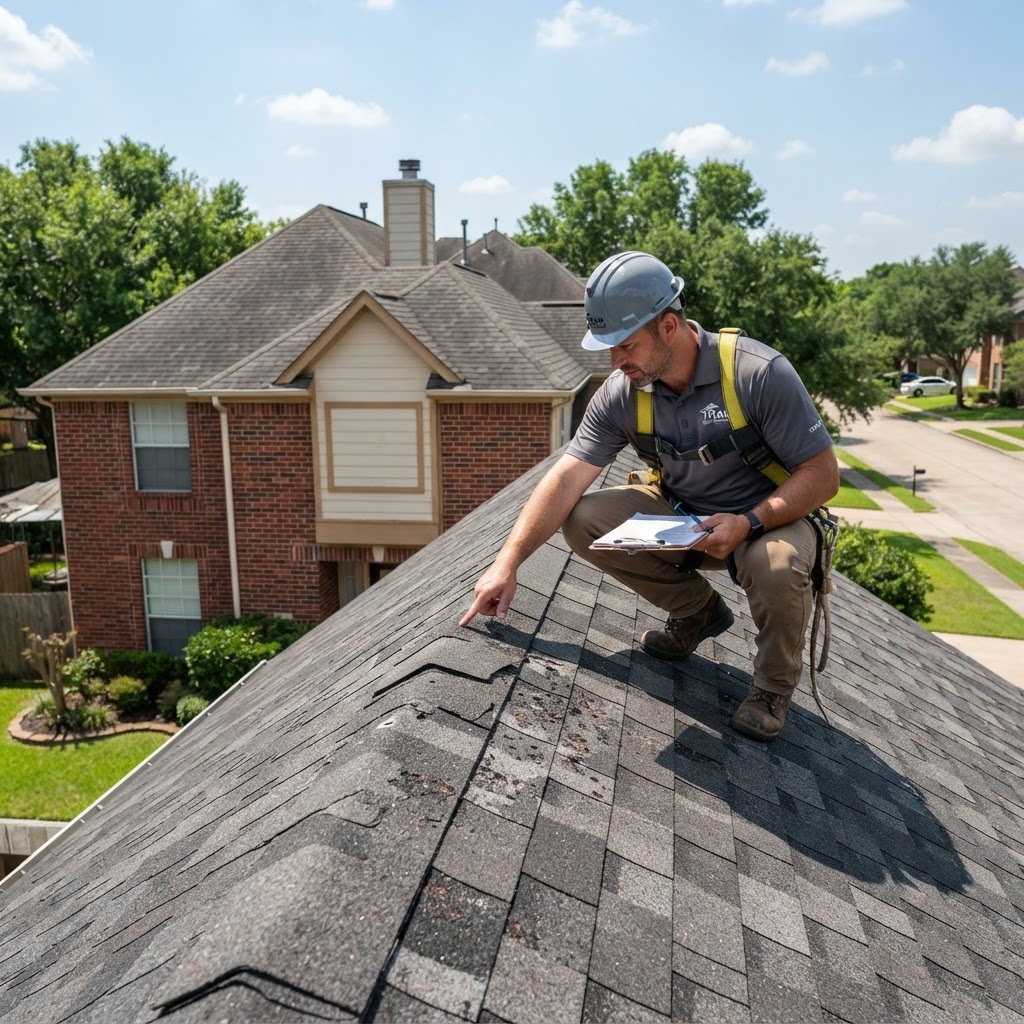
An adjuster standing in your driveway with binoculars for eight minutes cannot accurately assess granule loss patterns. It requires getting on the roof, using a granule loss mapping protocol, and in many cases, examining the gutters and downspout sediment, which will show you exactly how much material came off during impact.
The Adjuster Isn't Your Advocate — Understand That Dynamic
This isn't cynicism. It's just how the system works, and homeowners deserve to understand it.
Staff adjusters are employed by the insurance carrier. Independent adjusters are paid per-claim, often with implicit incentives tied to low settlement values. Neither group is malicious — most are doing their jobs as trained. But their financial incentive is not aligned with yours.
In Texas, you have the right to:
- Request a re-inspection with your contractor present
- Hire a licensed public adjuster to represent your interests
- Invoke the appraisal clause in your policy if you dispute the valuation
- File a complaint with the TDI if you believe your claim was handled in bad faith
Most homeowners never use these rights because they don't know they have them.
When Is Cosmetic Damage Actually Just Cosmetic?
Fairness requires saying this clearly: sometimes the exclusion is legitimately applied.
If you have a metal standing seam roof — popular in certain neighborhoods in The Woodlands and Sugar Land — small hail dimpling on flat panels genuinely may not affect function or longevity. If you have concrete tile and a few surface chips without cracking through to the underlayment, the case for functional damage is weaker.
The exclusion is most aggressively and incorrectly applied to:
- 3-tab and architectural asphalt shingles with measurable granule loss
- Older shingles (10+ years) where hail impact has cracked the asphalt mat beneath the granule layer — this requires hands-on inspection to identify
- Flashing and step flashing that has been displaced or creased — Houston's expansive clay soils cause constant foundation micro-movement, and flashing that was already under stress from seasonal shifting is frequently damaged by hail concussion in ways that don't look dramatic but absolutely leak
- Ridge cap shingles, which take disproportionate hail impact due to their exposed position and are almost always damaged worse than field shingles
The Freeze Event Factor Nobody Talks About
After Winter Storm Uri in February 2021, Houston saw a secondary wave of roofing failures that insurance companies largely avoided paying for. Here's the connection to cosmetic damage claims that most people miss:
Shingles that had sustained granule loss from prior hail events — many of which were settled as "cosmetic only" or simply not claimed — were dramatically more vulnerable to the freeze-thaw cycling during Uri. Water infiltrated micro-cracks in exposed asphalt, expanded during the freeze, and blew out flashing seals across tens of thousands of Houston homes.
The cosmetic damage from 2019 became the structural failure of 2021. Insurance companies paid almost none of it because the proximate cause was the freeze, not the original hail. Homeowners had no recourse.
This is the real long-term cost of accepting a cosmetic damage denial without scrutiny.
What You Should Do After Any Houston Hail Event
Here's a practical action list:
- Check your gutters within 48 hours of a significant storm. Visible granule sediment is photographic evidence. Take pictures.
- Do not wait months to file. Texas policies typically require timely notice of loss. Vague language in policies has been used to deny late-filed claims.
- Get a contractor inspection before the adjuster visit — not instead of it, but before. Know what's on your roof before someone else tells you.
- Ask your contractor specifically about flashing condition, ridge cap damage, and whether they observed any mat cracking beneath granule loss. These are the three findings that most reliably convert a cosmetic denial into a covered claim.
- Read your policy's cosmetic damage exclusion language carefully. Some policies define "cosmetic" extremely narrowly. Others have broader exclusions. The language matters enormously.
The Bottom Line
The roofing industry has a complicated relationship with insurance claims, and there are contractors who exaggerate damage just as there are adjusters who minimize it. The Houston homeowner caught between those two forces deserves straight information.
Granule loss is not cosmetic. Cracked asphalt mat is not cosmetic. Displaced flashing on a Houston home where the clay soil moves every wet season is not cosmetic. These are functional failures on a timeline — and the timeline is shorter in Houston than almost anywhere else in the country.
If you've received a cosmetic damage denial after a recent Harris County storm and you're not sure whether to accept it, get a second opinion from a licensed contractor who will actually get on the roof. The inspection should be free. The information could save you a re-roof out of pocket in three years.
FairClaims Roofing & Construction offers no-obligation storm damage inspections throughout the Greater Houston area. If you want someone who will tell you honestly what's up there — good news or bad — that's the starting point.
Need a roof inspection?
FairClaims Roofing & Construction offers free inspections across the Texas Triangle.
Click to Call