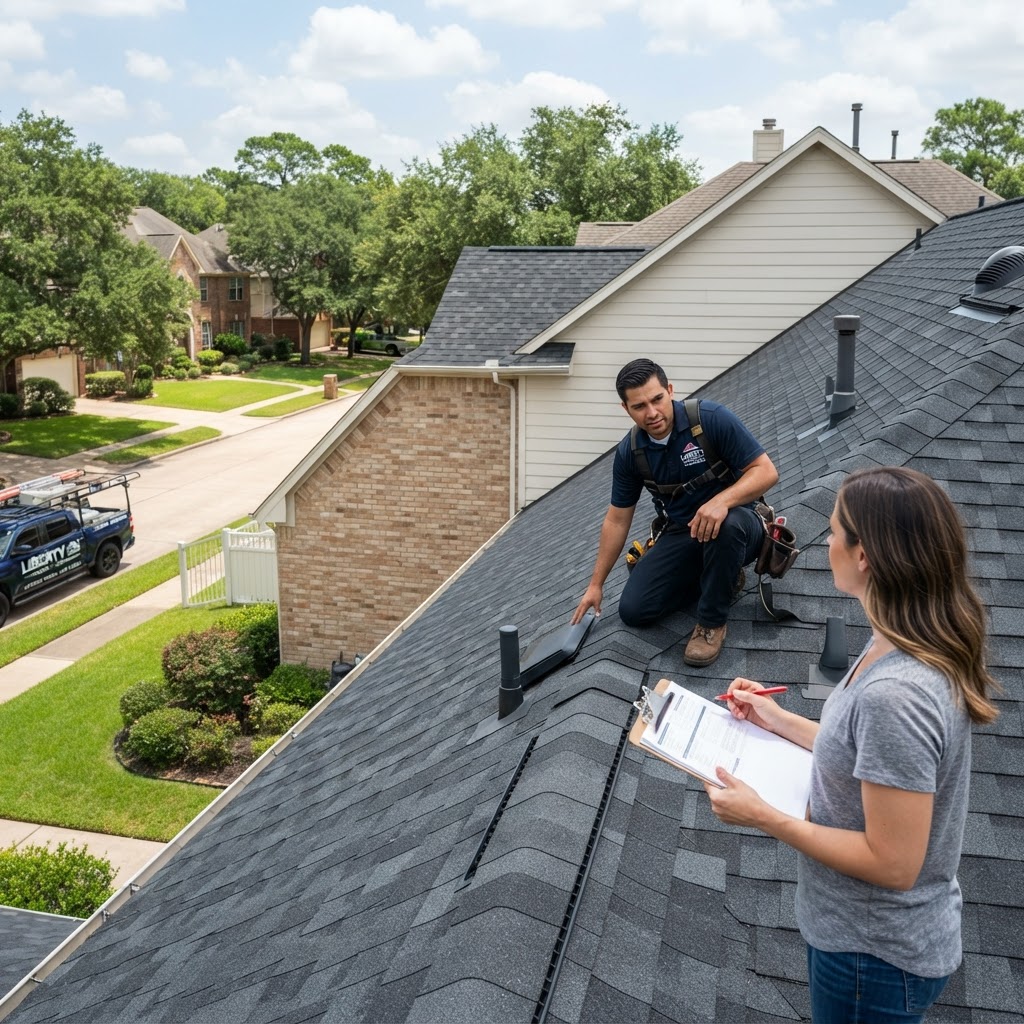
The Houston Homeowner's Insurance Claim Playbook: How to Document Storm Damage, Work the Adjuster, and Not Leave Money on the Table
After 20+ years on Houston-area roofs, we've watched homeowners lose thousands to underpaid claims — not because they were dishonest, but because they didn't know the rules of the game. Here's exactly what to document, what adjusters are trained to look for, and how to protect yourself from the moment hail hits your neighborhood.
The Houston Homeowner's Insurance Claim Playbook: How to Document Storm Damage, Work the Adjuster, and Not Leave Money on the Table
Houston doesn't give you much warning. A pop-up supercell rolls through Cy-Fair on a Tuesday afternoon, drops golf ball-sized hail for eleven minutes, and by the time you look out the window it's sunny again. Two weeks later, your neighbor has a brand-new roof. You file a claim and the adjuster hands you a check for $4,200 — but three roofing contractors have told you the job costs $18,000.
That gap isn't an accident. It's a process, and you can learn it.
We've been on thousands of roofs across Greater Houston, The Woodlands, Katy, Pearland, and Sugar Land. Here's what we've learned about how insurance claims actually work — from the moment the storm ends to the moment you cash that final check.
Step 1: Document Before You Do Anything Else
The 48-72 hours after a storm are your most important window. Before you call your insurance company, before you let anyone put a tarp on your roof, document everything yourself.
What to photograph and video:
- Every downspout and gutter (hail leaves circular dents — adjusters call these "spatter marks" and they're one of the fastest ways to confirm hail size)
- Your HVAC condenser unit on the roof or ground (soft metals like aluminum fins dent easily and act as a calibration tool for hail size)
- Window screens, if you still have them — they show impact patterns clearly
- Any skylights, pipe boots, or lead flashing (these show damage that's easy to miss on shingles but impossible to fake)
- The ridge cap specifically — it takes hits from multiple angles and is often the most obvious indicator
- Your fence if it's cedar or wood — hail bruising on soft wood is compelling photo evidence
Timestamp every photo. Enable location tagging on your phone camera. Upload everything to cloud storage the same day.
One thing most homeowners miss: Screenshot the weather radar for your exact address during the storm. The National Weather Service archives storm reports at weather.gov, and sites like Hail Trace or CoreLogic can give you a certified hail report showing storm path and hail size at your GPS coordinates. These reports cost $10-25 and can single-handedly validate your claim if an adjuster tries to dispute that your neighborhood was actually hit.
Step 2: Understand What the Adjuster Is Actually Measuring
Insurance adjusters don't just look at shingles and say yes or no. They use a specific methodology, and knowing it changes how you approach the inspection.
For asphalt shingles like GAF Timberline HDZ or Owens Corning Duration (both common upgrades in Houston-area builds from 2015 onward), adjusters are looking for functional damage — not cosmetic damage. This distinction is where homeowners get burned.
A bruised shingle — one where the granule mat is knocked away, exposing the fiberglass mat beneath — is functional damage. It will accelerate UV degradation (Houston's UV index from May through September is brutal, regularly hitting 10-11 out of 11), allow moisture intrusion, and shorten the roof's life by years. An adjuster who writes it off as "cosmetic" is wrong, and you can push back.
Here's a technique adjusters use that you should know: the chalk circle test. An adjuster will mark out a 10-foot by 10-foot square on multiple roof sections and count the number of impact points within that square. Most carriers require a minimum of 8-10 functional hits per square to approve replacement of that section. If your adjuster is rushing through this process or only testing one slope, ask them to test all four. Storm direction matters — the northwest-facing slope of a roof in the path of a typical Houston supercell (which usually tracks from the southwest) will always show more damage than the leeward slope.
Step 3: Know Your Policy Before the Adjuster Arrives
Pull out your declarations page and find two specific things:
1. RCV vs. ACV Replacement Cost Value (RCV) means the insurer pays what it costs to replace your roof with like materials today. Actual Cash Value (ACV) means they depreciate the roof based on age and pay you the remainder. If you have a 12-year-old roof on an ACV policy, you might get 40 cents on the dollar. Many Texas homeowners don't realize they have ACV coverage until they file a claim.
2. Your wind/hail deductible Since 2012, most Texas carriers — State Farm, Allstate, USAA, Farmers, and especially the regional carriers like TGS Insurance or Southern Vanguard — moved to percentage-based wind/hail deductibles rather than flat deductibles. If your home is insured for $400,000 and you have a 2% wind/hail deductible, you're paying $8,000 out of pocket before coverage kicks in. That's not a reason to skip filing — a legitimate $20,000 roof claim still nets you $12,000 — but it explains why the numbers don't always add up the way you expect.
Step 4: The Supplement Process (Most Homeowners Never Do This)
Here's the part of insurance claims that nobody tells you about, and it's where the real money is recovered.
When an adjuster writes an estimate, they use Xactimate software — an industry-standard pricing tool. The problem is that Xactimate prices are updated quarterly and often lag behind real labor and material costs in high-demand markets. After a major hail event like the April 2024 storm that cut across north Houston into The Woodlands, or the widespread damage from Hurricane Beryl in July 2024, contractor pricing spikes because everyone needs work done at once.
Supplementing is the process of going back to the insurance company with documented line items they missed or underpriced. Common legitimate supplements include:
- Drip edge replacement (frequently left off initial estimates)
- Ice and water shield in required areas (Texas code requires it in valleys)
- Satellite dish detach and reset
- Permit fees (required in Harris County and most municipalities)
- Updated material pricing based on current supplier invoices
- Additional layers if your roof has a recover layer that must be torn off
A thorough contractor — one who has experience working with insurance scopes — will submit a detailed supplement on your behalf. At FairClaims Roofing & Construction, supplementing is a standard part of our insurance claim process because we've seen estimates come in 20-35% below actual project cost on a regular basis.
Step 5: Red Flags That Should Make You Push Back
- Adjuster denies the claim citing "pre-existing damage" without specifying what that damage is or where it's located
- The estimate lists only partial replacement (one slope) when damage is visible on all slopes
- No mention of interior inspection when you have active ceiling stains
- Depreciation percentage that seems unusually high given your roof's actual age and maintenance history
- Estimate written with a per-square price significantly below current Houston contractor rates ($450-$650 per square installed for architectural shingles, as of mid-2026)
You have the right to request a re-inspection. You have the right to hire a licensed public adjuster. And you have the right to invoke the appraisal clause in your Texas insurance policy — a formal dispute process that brings in a neutral umpire to settle disagreements on value. It costs money and time, but on a disputed $15,000 claim, it's often worth it.
One Last Thing: Timing Matters More Than You Think
Texas insurance policies generally give you one year from the date of loss to file a claim, but some carriers have pushed this to two years. However, waiting is almost never in your favor. The longer you wait, the more the damage compounds — Houston's humidity drives moisture into any exposed decking within weeks, and what was a $16,000 roof claim in August can become a $22,000 claim by January once you factor in decking replacement. File promptly, document thoroughly, and know your rights.
If you've received an insurance estimate that doesn't feel right — or you just want a second opinion before you accept payment — schedule a free scope review with our team. We'll walk your roof, review the adjuster's estimate line by line, and tell you exactly where the gaps are. No pressure, no obligation.
Need a roof inspection?
FairClaims Roofing & Construction offers free inspections across the Texas Triangle.
Click to Call