The Conroe Homeowner's Roof Insurance Claim Playbook: How to Document Damage, Work the Adjuster Visit, and Avoid Getting Underpaid
After a hail storm rolls through Montgomery County, most homeowners leave thousands of dollars on the table during the claims process. Here's the insider guide — from a contractor who's been on the roofs and in the trenches with adjusters — on how to protect your payout from day one.
The Storm Is Over. Your Real Work Is Just Beginning.
Conroe gets hit hard. We're not talking about the gentle, predictable Gulf Coast rain that insurance actuaries model in Tampa or Orlando. We're talking about the violent, fast-moving supercells that drop golf ball hail on your street while the neighborhood two miles away stays bone dry. Montgomery County sits right in the teeth of Texas's primary hail corridor, and from March through June — and again in the fall shoulder season — pop-up storms can go from clear skies to quarter-size hail in under 20 minutes.
I've been on roofs across the Texas Triangle for over two decades. I've stood next to insurance adjusters during hundreds of inspections. And the single most consistent thing I see? Homeowners who did everything right after the storm still got shortchanged — not because their damage wasn't real, but because they didn't know how the process actually works.
This guide fixes that.
Step 1: Document Before You Touch Anything
The 48 hours after a storm are your most valuable window. Here's exactly what to capture:
On the ground (don't go on the roof yourself):
- Photograph every piece of hail on your driveway, deck, AC unit, and window screens. Place a coin or tape measure next to it for scale. Size matters enormously — anything 1 inch (quarter size) or larger is a threshold many carriers use to classify "severe" hail damage.
- Photograph dents in your gutters, downspouts, aluminum soffit, and any metal flashing visible from the ground. These soft-metal impacts are objective, measurable proof of hail size and energy — and adjusters know it.
- Check your AC condenser fins. Heavy hail destroys them. This often becomes a separate claim line item that homeowners miss entirely.
- Note the date and time and cross-reference with a storm report. The NOAA Storm Events Database and weather services like Understory (formerly Tomorrow.io) provide granular, address-level hail reports that can be pulled later. Get one now while the date is fresh.
Interior documentation:
- Walk your attic within 24–48 hours. In Conroe's humidity, a cracked or displaced shingle can introduce moisture that starts degrading your decking almost immediately. Look for daylight pinpoints, wet insulation, or dark staining on the decking boards.
- If you have any ceiling water stains that appeared after the storm, photograph them before they dry. A dried stain is far harder to tie to a specific event in a dispute.
Step 2: Understand What Adjusters Are Actually Looking For
Here's the insight most homeowners never get: insurance adjusters are not roofing experts. They are claim processors working against a schedule, often inspecting 15–20 properties per day after a major event. They follow a checklist, and if your damage doesn't match what's on that checklist, it can disappear from the estimate.
The industry standard estimating software is Xactimate. Adjusters build their repair or replacement scope inside this platform. Every line item — remove and replace shingles, felt underlayment, ice and water shield, ridge cap, drip edge — has a code, and if it isn't entered, it isn't paid.
What commonly gets missed by adjusters in Montgomery County:
- Drip edge replacement: Required by current code on a full replacement, but frequently omitted from Xactimate estimates. In Texas, this is often a $300–$600 line item that just vanishes.
- Pipe boot flashing: Rubber boots cracked by hail or UV degradation (and Conroe's summers are brutal on rubber — consistent 95°F+ temperatures for months accelerate this) are often listed as "pre-existing." They're not always. Document their condition before the adjuster arrives.
- Decking replacement: Adjusters typically don't open decking during an inspection. If your roof is older or has moisture damage, you may need to negotiate this after tear-off begins. Get it in writing that your contractor will document and photograph any bad decking before covering it.
- Overhead and profit (O&P): This is a 20% markup that general contractors are entitled to on complex jobs involving multiple trades. Insurers frequently omit it on roofing claims. Ask your contractor if they're including it in their scope — it can represent $1,500–$4,000 on an average Conroe home.
- Code upgrades: If your home was built before 2012, there's a reasonable chance your roof doesn't meet current IRC or Texas-specific code requirements. Many policies include "Ordinance or Law" coverage. Check your declarations page — this endorsement can cover the cost difference between repairing to old code and building to new.
Step 3: The Adjuster Visit — What to Do and Not Do
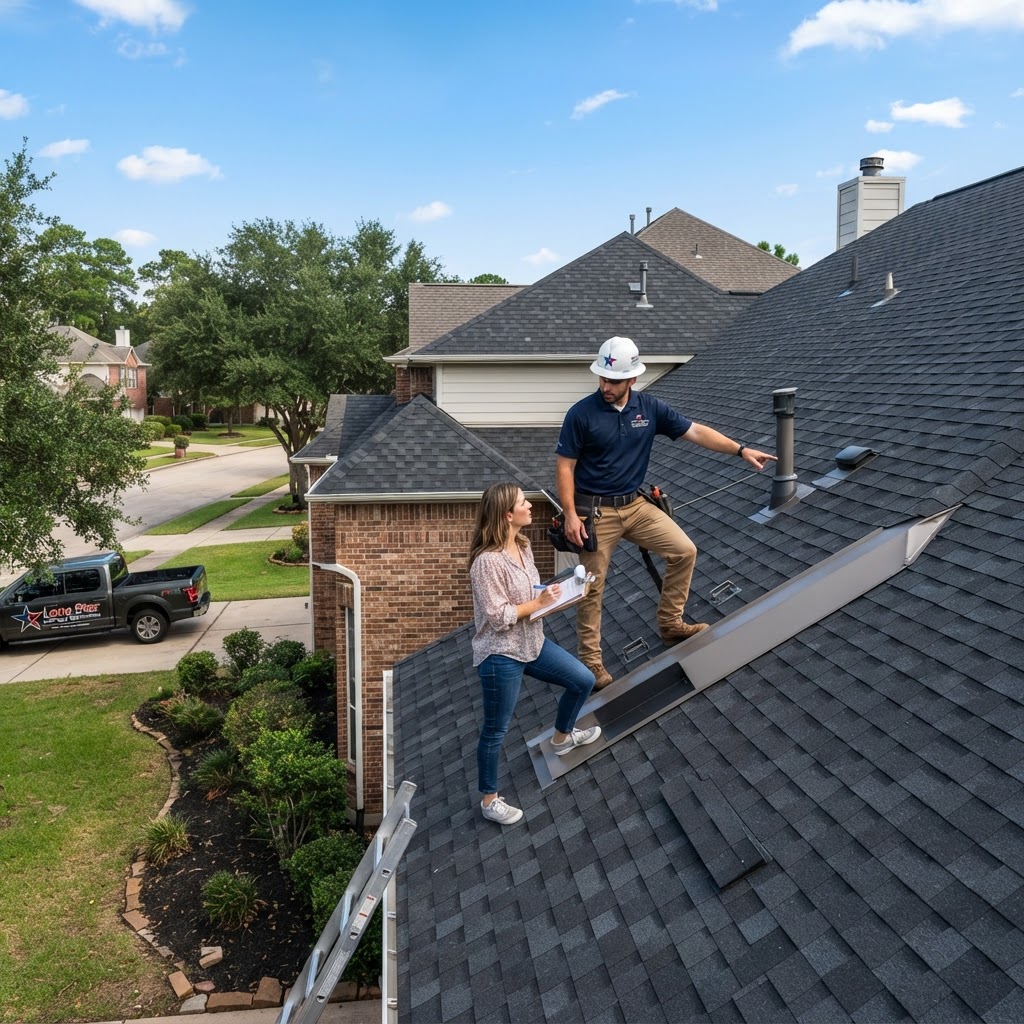
Be present. Always. An adjuster who walks a roof alone for 20 minutes will find what they find. An adjuster who knows a knowledgeable contractor or informed homeowner is present tends to be more thorough.
You don't need to argue. You need to ask questions:
- "Can you walk me through what you're finding on the north slope?"
- "Are you noting the gutter damage as evidence of hail size?"
- "Is drip edge included in your scope?"
If the adjuster's scope comes in significantly lower than a contractor estimate you've received, you have the right to invoke the appraisal clause in your policy (almost every Texas homeowner policy includes one). This brings in a neutral umpire to settle the dispute. It's not litigation — it's a built-in policy mechanism that insurers don't always advertise.
A word on timing: Texas Insurance Code Section 542 requires carriers to acknowledge a claim within 15 days and accept or reject it within 15 business days of receiving all requested information. If your carrier is dragging their feet past these windows, that's not just frustrating — it may be a violation. Document every phone call with date, time, and rep name.
Step 4: Know the Montgomery County-Specific Complications
Conroe and the surrounding Montgomery County area have some quirks that affect claims:
- Foundation movement and flashing failures: The expansive clay soils throughout the Conroe area — especially in neighborhoods built in the 1990s and early 2000s near Lake Conroe — cause subtle structural movement that opens up step flashing and valley flashing over time. Insurers sometimes try to tag these as maintenance issues. They're often storm-aggravated conditions, especially after a hail event puts lateral stress on a structure.
- Wind-driven rain under ridge caps: Our Gulf-influenced storms often come with 50–70 mph gusts. Ridge cap blow-offs are common and are distinct from hail damage — they're covered under wind damage provisions, not hail, and are sometimes inadvertently excluded when an adjuster writes a hail-only scope.
- Two-story and steep-slope roofs: Common in newer master-planned communities around Conroe (Woodforest, Grand Central Park, Harmony). These require additional labor that must be explicitly called out in an Xactimate scope. Flat rates don't apply.
The Supplementing Process — It's Normal and Expected
Here's something that surprises most homeowners: the first adjuster estimate is rarely the final one. In the industry, this is called supplementing. Once tear-off begins and a contractor documents actual conditions — bad decking, rusted flashing, missing drip edge, deteriorated pipe boots — those findings get submitted back to the carrier with photos and Xactimate line items.
A good roofing contractor will handle this process for you. It's not combative. It's documentation-driven. At FairClaims Roofing & Construction, we've supplemented hundreds of claims in the Greater Houston and Conroe area and routinely recover 15–30% above the initial adjuster estimate once all legitimate line items are properly scoped.
One Final Rule: Don't Wait
Texas has a two-year statute of limitations on most property insurance claims, but waiting even a few months creates problems. Storm dates become harder to establish. Damage gets attributed to wear and tear. Carriers get skeptical. The sooner you initiate and document, the stronger your position.
If you're not sure whether your roof sustained damage in a recent storm, a professional inspection costs you nothing and gives you a documented baseline. Schedule a free storm damage inspection with our team — we'll tell you honestly what we see, give you a written report with photos, and if there's no claim-worthy damage, we'll tell you that too.
Knowing your roof is solid is worth something. Knowing you got paid fairly for the damage you actually have is worth a lot more.
Need a roof inspection?
FairClaims Roofing & Construction offers free inspections across the Texas Triangle.
Click to Call