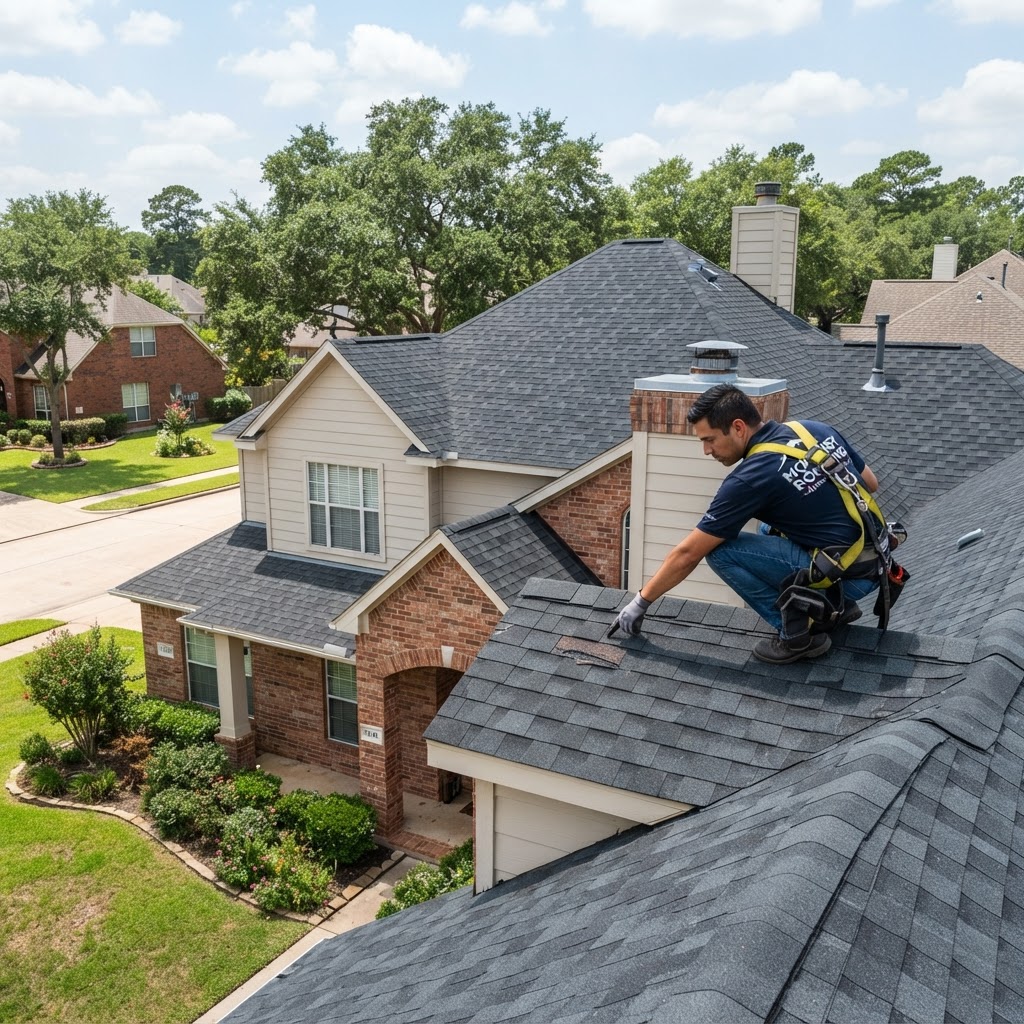
Small Signs, Big Problems: 7 Roofing Warning Signs Magnolia Homeowners Should Never Ignore
That tiny dark spot on your ceiling or the slight curl on a shingle edge might look like nothing. But after 20 years on Texas roofs, we can tell you — the small stuff is almost always telling a bigger story. Here's what to watch for before a minor fix turns into a major claim.
Why Magnolia Roofs Have It Harder Than Most
Magnolia sits in a weather pressure cooker. You're close enough to the Gulf that you catch the tail end of tropical moisture systems, but you're also right in the path of the spring and fall hail corridors that sweep through Montgomery County. Add in the notorious August UV intensity — Houston-area roofs routinely hit 160°F surface temperatures during peak summer — and you've got an environment that exposes every weakness a roof has.
We've been on roofs all over the Texas Triangle for more than two decades. The pattern we see over and over: a homeowner notices something small, waits to see if it gets worse, and by the time they call us, what should have been a $400 flashing repair has turned into a $14,000 partial replacement with interior damage on top of it.
Here are seven warning signs that look minor from the ground — and what they're actually telling you.
1. A Single Lifted Shingle Tab After Wind
After any storm event — especially the pop-up 60-70 mph derecho-style gusts Magnolia gets in late spring — it's tempting to walk the perimeter, see one lifted tab, and move on. Don't.
When a shingle tab lifts, the sealant strip (the factory-applied adhesive line under each shingle) has either failed or been breached. On GAF Timberline HDZ shingles, that StainGuard Plus sealant strip is the primary wind defense. Once it breaks, water gets underneath and begins working laterally — often 3 to 4 shingle courses in either direction before you ever see a ceiling stain.
What it actually signals: Adjacent shingle adhesion failure, possible nail pop exposure, and the beginning of a water migration path.
2. Granule Loss That Looks "Cosmetic"
You clean out your gutters and notice a sandy residue — looks brownish, kind of like coarse sand. That's granule loss, and in Montgomery County's UV environment, it's a serious clock-ticking issue.
Granules are your shingle's primary UV shield. Asphalt without granule protection degrades roughly 4 to 6 times faster than intact shingles in direct Texas sun. A shingle that loses 20% of its granule coverage in July can be visibly cracking and brittle by October — right before fall hail season hits.
Surprising insight: Granule loss is often asymmetric. The south- and west-facing slopes of your roof take the hardest UV punishment in Texas. If you're seeing heavy granule fallout from just one section, that slope may be 5 to 8 years behind the rest of your roof in terms of remaining lifespan.
3. A Small Rust Stain Around a Pipe Boot
Pipe boots — the rubber or metal flashing collars around plumbing vents — are the single most common entry point for water on a Texas roof. The rubber versions (common on homes built in the late 1990s through mid-2000s in communities like Magnolia's older subdivisions near FM 1488) crack from UV and thermal cycling in as little as 7 to 10 years.
A faint rust streak down your shingles from a pipe penetration means the metal collar beneath the rubber is already compromised. By the time you see visible rust, water has typically been entering the substrate for weeks or months.
Cost comparison: Pipe boot replacement runs $150–$350. Water-damaged decking and attic insulation from a neglected boot: $2,000–$6,000.
4. Nail Pops That "Just Look Ugly"
Foundation movement in Montgomery County is constant. The expansive clay soils that run through much of the greater Magnolia area swell in the summer rains and contract hard in drought. That movement transfers up through your walls and into your roof deck — and one of the first visible symptoms is nail pops: small bumps under the shingle surface where nails have backed out of the decking.
Most homeowners see this and think it's an aesthetic issue. It's not. A backed-out nail creates a micro-gap in the shingle layer. Under driven rain — the kind that comes at a 45-degree angle during a Montgomery County thunderstorm — that gap channels water directly into the deck.
What to ask: If you have more than 2–3 nail pops per 100 square feet, have a roofer evaluate whether you have systemic deck movement or isolated fastener failures. These are two very different repair scopes.
5. A Faint Dark Streak on Your Ceiling (Not Growing)
This is the one homeowners dismiss most often. "It's not getting bigger, so it's probably fine."
Here's the thing: ceiling stains grow in phases. Water infiltrates, saturates insulation, then dries during Texas's brutal summer heat — sometimes completely. The stain stabilizes. Then the next rain event adds more. The reason it looks "stable" is because your attic insulation is acting as a sponge, hiding the true volume of intrusion.
By the time a ceiling stain starts actively dripping or growing fast, you're typically looking at saturated decking, compromised insulation R-values, and possible mold colonization in the attic cavity.
6. Flashing That's "Just a Little" Separated
Chimney flashing, valley flashing, and step flashing along dormers are the most labor-intensive parts of a roof to do correctly — and the most commonly cut-corner items on lower-quality re-roofing jobs. In Magnolia, foundation movement (see point 4) makes flashing separation a chronic issue.
A 1/8-inch gap in step flashing looks like nothing. In a 2-inch-per-hour rainfall event — common in Montgomery County from May through September — that gap can channel 2 to 4 gallons of water per hour directly onto your wall framing.
Red flag for insurance claims: Texas insurers including State Farm, Allstate, and USAA have become increasingly aggressive about denying water damage claims where pre-existing flashing separation is documented. If you have even minor flashing gaps before a storm event, your claim can be partially or fully denied as "maintenance neglect." Fix it before storm season, not after.
7. An Attic That's "A Little Warmer Than Usual" in Summer
Most homeowners never go in their attic in August. We understand — it's 130°F up there. But if your HVAC is running harder than normal and your upstairs rooms feel stuffy even with the AC on full, your attic ventilation may be failing.
Poor attic ventilation is both a symptom and a cause of roofing problems. When attic temps exceed 160°F, the adhesives in your decking begin to soften and the factory sealant strips on your shingles lose effectiveness from below. In high-humidity Magnolia summers, a poorly ventilated attic also creates condensation cycles that slowly rot decking from the inside out — damage you'll never see from the ground.
What good ventilation looks like: A properly ventilated attic should have 1 square foot of net free ventilation area per 150 square feet of attic floor space. Ridge vents combined with soffit intake vents (not just power attic ventilators) provide the most consistent airflow.
The Uncomfortable Truth About "Waiting to See"
We tell every homeowner the same thing: roofs don't give you warning signs to be polite. They give them to you because the failure has already begun. What you're seeing is the surface expression of a process that started weeks or months ago.
The best time to catch these issues is after every major storm event — and once each year in early spring before hail season and once in early fall before hurricane season's final push. A qualified contractor should be on your actual roof, not doing a "drive-by" assessment from the street.
If any of these warning signs sound familiar, the team at FairClaims Roofing & Construction offers free roof assessments for Magnolia-area homeowners — no obligation, no pressure, just an honest evaluation from a GAF Master Elite® certified contractor who will put findings in writing.
Schedule your free inspection at fairclaims.com or call us directly. Know what you're dealing with before the next storm makes the decision for you.
Need a roof inspection?
FairClaims Roofing & Construction offers free inspections across the Texas Triangle.
Click to Call