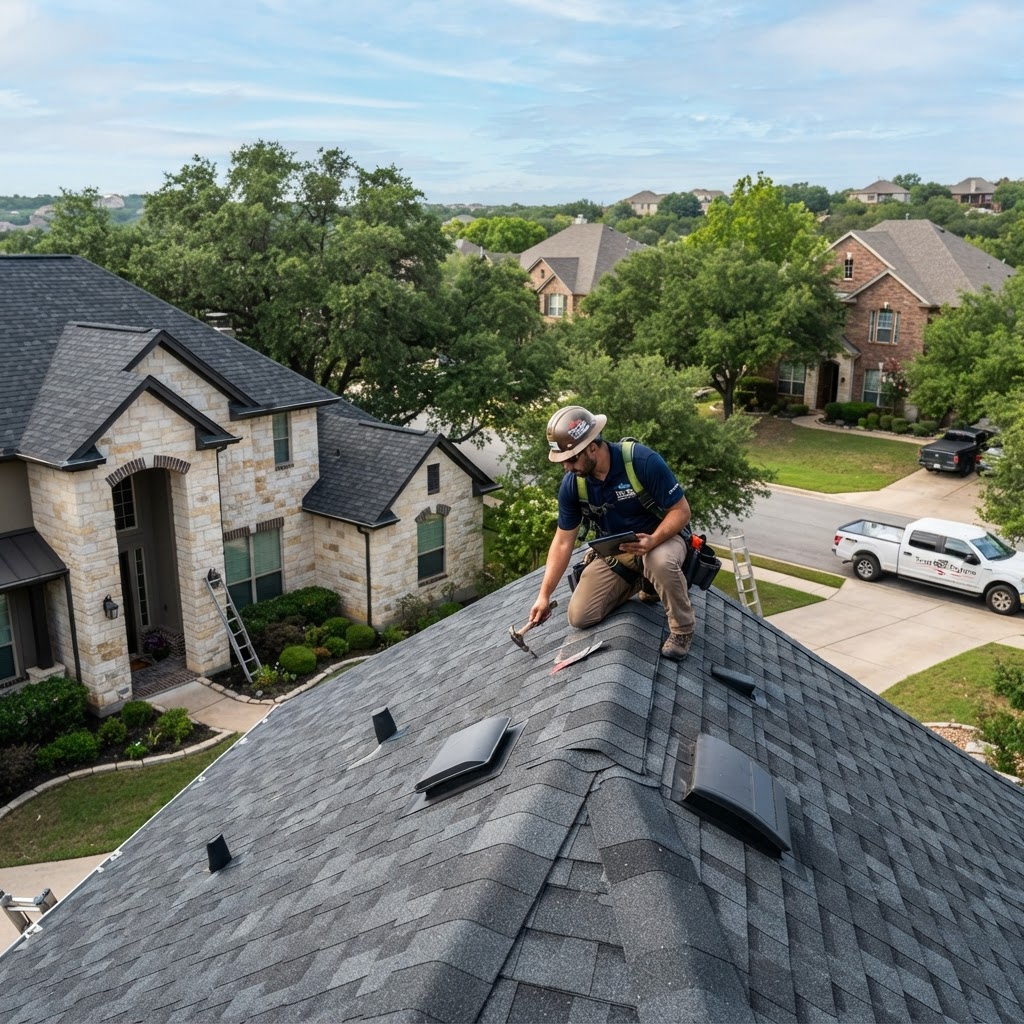
Repair vs. Replace After an Austin Hailstorm: The Honest Decision Guide Most Contractors Won't Give You
After a hailstorm rolls through Austin, every roofing contractor in town suddenly has an opening in their schedule. Here's how to cut through the noise and make the repair-vs-replace decision based on real damage criteria — not a salesperson's quota.
Repair vs. Replace After an Austin Hailstorm: The Honest Decision Guide Most Contractors Won't Give You
It's late May. A pop-up storm cell that barely registered on the morning radar drops half-dollar hail across the Arboretum, Northwest Hills, and Steiner Ranch in about 22 minutes. By the next morning, you've got three contractors leaving door hangers and a neighbor who swears his insurance company already approved a full replacement. You're staring at your roof wondering: do I actually need a new roof, or does someone just want to sell me one?
This guide is designed to help you answer that question honestly — based on what the damage actually looks like, how old your roof is, and how Austin's specific climate stacks the deck in ways most homeowners don't fully understand.
Why Austin Hail Damage Is Different From What You'll Read Online
Most generic roofing content is written for a national audience. Austin's situation is more specific:
- Storm patterns: The Texas Hill Country acts as a thermal boundary that generates some of the most intense isolated supercells in North America. The March–June hail window and the secondary September–October window mean Austin roofs get hit harder and more frequently than most U.S. markets.
- UV degradation: Austin averages over 220 sunny days per year. Asphalt shingles lose granules and oxidize faster here than in, say, Chicago. A 10-year-old shingle in Austin may be functionally closer to 14 years old in terms of impact resistance.
- Foundation movement: Austin's expansive clay soils — the same ones that crack driveways and shift pier-and-beam foundations — cause subtle but real movement in your roof deck and fascia over time. That movement compromises step flashing, valley metal, and pipe boot seals before hail ever enters the picture.
- Attic heat: Attic temperatures in Austin routinely hit 150–160°F in summer. That heat accelerates shingle adhesion strip degradation, which is the strip that keeps shingles sealed against wind uplift. A hailstorm on an already heat-compromised roof isn't just a cosmetic problem.
All of this means that when a hailstorm hits, you're not just evaluating the damage from that event — you're evaluating a roof that has already been aging under punishing conditions.
The Four Damage Indicators That Actually Matter
When you (or a contractor) get on the roof after a storm, here's what separates cosmetic damage from functional damage:
1. Granule Loss Concentration
Scattered granule loss is cosmetic. What matters is whether you have bare mat exposure — spots where the asphalt substrate is visible. Bare mat on more than 10–15% of individual shingles is a replacement indicator, not a repair indicator.
2. Bruising vs. Cracking
Press your thumb firmly on a suspected impact point. If the shingle feels soft and spongy — like a bruised apple — the mat fibers beneath have fractured. That's structural damage that accelerates moisture intrusion. Cracked or split shingles in a hail pattern are an unambiguous claim trigger. Bruising is subtler but often more significant long-term.
3. Pattern Distribution
Hail damage should follow a directional pattern based on wind direction during the storm. If a contractor shows you damage that's randomly distributed across all roof faces, that's wear — not fresh hail. Legitimate hail damage clusters on the leading-face slopes and shows consistent impact sizing. Insurance adjusters from State Farm, Allstate, and USAA are all trained to look for this pattern consistency.
4. Functional vs. Cosmetic Damage Threshold
Texas Department of Insurance guidelines distinguish between cosmetic damage (dents and dings that don't affect waterproofing) and functional damage (compromised waterproofing integrity). If your policy includes a cosmetic damage exclusion — increasingly common in Central Texas policies since 2021 — you need functional damage documented to trigger a claim. A contractor who only photographs granule loss isn't building you a defensible claim.
Repair vs. Replace: The Honest Decision Matrix
| Situation | Likely Best Path | Why | |---|---|---| | Roof under 7 years old, damage isolated to 1–2 squares | Repair | New materials blend well; structural integrity intact | | Roof 8–15 years old, damage on primary slopes | Replace | UV/heat degradation means patched sections age faster than surrounding field | | Roof over 15 years old, any measurable hail damage | Replace | At this age in Austin's climate, you're borrowing time regardless | | Roof under 10 years old, bruising on 30%+ of shingles | Replace + Insurance Claim | Functional damage threshold likely met; full replacement protects resale value | | Damage isolated to one pipe boot or valley | Repair | Component replacement is cost-effective and appropriate |
A note on the "age cutoff" logic: This isn't arbitrary. GAF's own warranty data shows that shingles in high-UV, high-heat environments like Central Texas show measurable performance degradation starting around year 8. Repairing an already-degraded roof often means you're paying for materials that will fail before the rest of the roof does anyway.
What a Repair Actually Costs (And When It Stops Making Sense)
In the Austin market as of mid-2026:
- Single pipe boot replacement: $150–$250
- Valley re-flashing (per valley): $350–$600
- Shingle repair (1–2 squares): $400–$900 depending on pitch and access
- Full replacement (2,000 sq ft, architectural shingles): $14,000–$22,000 depending on pitch, complexity, and material tier
The "repair vs. replace" math changes fast. Once you're looking at $2,500–$3,500 in repairs on a roof that's 12+ years old, a full replacement often pencils out better — especially if you can get insurance involved on the functional damage portion.
Here's the insight most contractors skip: a partial insurance claim for repairs can actually work against you. In Texas, filing a claim that results in a repair payment — rather than full replacement — still counts as a claim on your record with your carrier. If you file for repairs today and need a full replacement in 18 months after the next storm, your second claim may face a higher scrutiny threshold or a non-renewal trigger. If your roof is in the 10–15 year range and has functional damage, it's often worth documenting the full scope now and making the complete case.
How to Evaluate a Contractor's Damage Assessment
After a major storm event — like the April 2024 hail outbreak that tracked from Waco through Round Rock into South Austin — the number of out-of-state storm chasers in the market is extraordinary. Here's how to pressure-test what you're being told:
- Ask for a written damage report with photos, not a verbal assessment on the driveway.
- Verify RCAT licensing through the Texas Department of Licensing and Regulation (TDLR). Texas requires roofing contractors to be registered — it's a consumer protection law, and unlicensed contractors operate here constantly after major storms.
- Ask whether the contractor carries separate hail damage documentation tools — most legitimate companies use Haag Engineering standards or equivalent impact testing protocols.
- Get the storm date confirmed against hail reports from the NOAA Storm Events Database or a service like Verisk. A contractor should be able to tell you exactly what size hail hit your address on what date.
- Don't sign an Assignment of Benefits (AOB) agreement without reading it carefully. Some Austin-area contractors use AOB language that transfers your claim rights to them, limiting your ability to dispute scope or settlement amounts later.
The Bottom Line
The repair-vs-replace decision after an Austin hailstorm isn't just about the damage in front of you — it's about the age of your roof, the UV and heat exposure it's already absorbed, the claim history implications, and whether a repair actually extends your protection or just delays the inevitable.
If you're unsure where your roof stands, the most useful first step is a documented inspection from a contractor who will put their findings in writing and reference specific damage criteria — not just tell you what you want to hear.
FairClaims Roofing & Construction offers post-storm inspections for Austin-area homeowners with a written damage report, storm date verification, and no-pressure repair vs. replace recommendation. If you've had hail recently and want a second opinion on what you're actually dealing with, that's the right starting point.
Request your written inspection report before you file anything with your insurance company. What you document first shapes every conversation that follows.
Need a roof inspection?
FairClaims Roofing & Construction offers free inspections across the Texas Triangle.
Click to Call