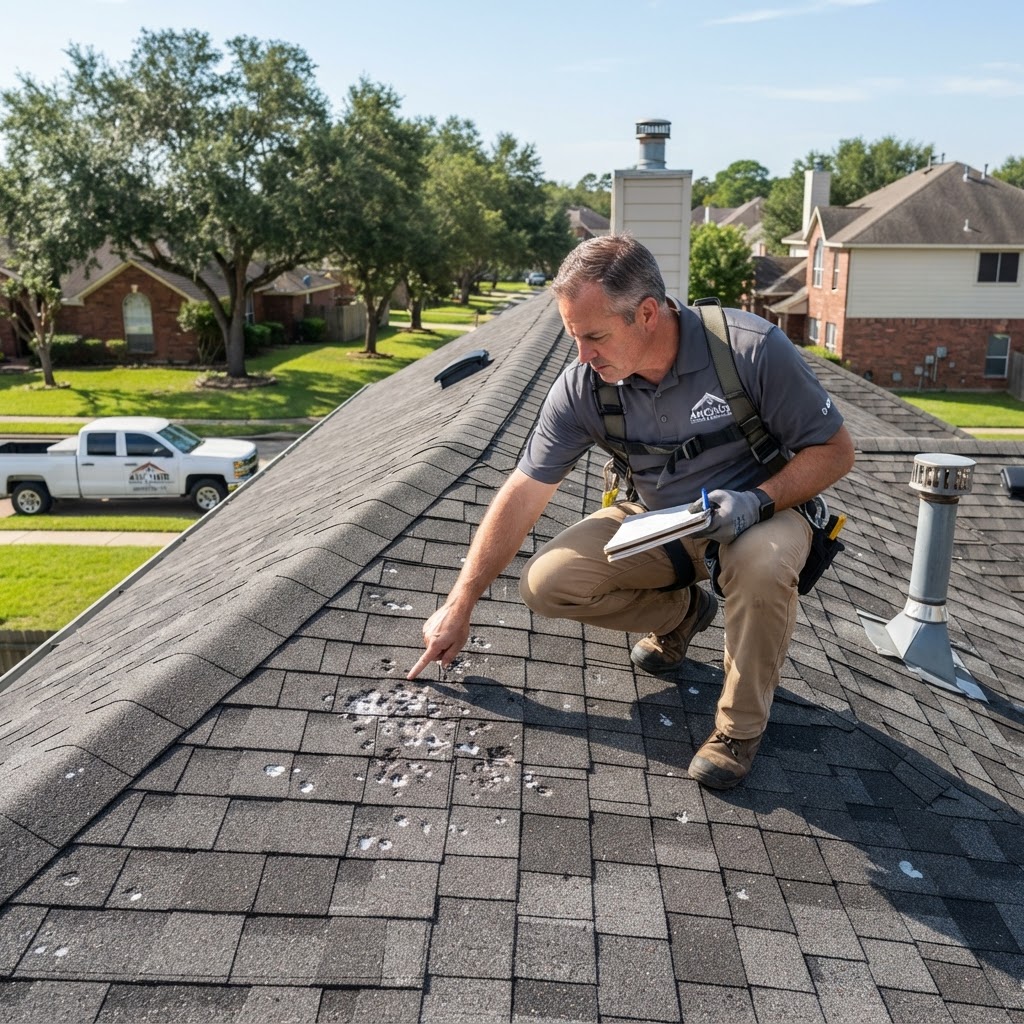
How to Read Your Roof After a Houston Hail Storm: A Step-by-Step Field Guide Before You Call Your Insurance Company
Most Houston homeowners file hail claims too early — or too late. Here's exactly how to document roof damage like a pro, what real hail damage looks like versus normal wear, and how to avoid the mistakes that get claims denied.
The 72-Hour Window That Can Make or Break Your Claim
Every spring and fall in Houston, we go through the same cycle. A pop-up supercell drops golf-ball-sized hail on Katy or Humble, and within 48 hours, every roofing company in the Texas Triangle has canvassers knocking on doors. Some of those contractors are legitimate. Many are storm chasers who'll be gone before your roof leaks next season.
But here's what most homeowners don't know: what you do in the 72 hours after a hail event directly affects whether your claim gets approved, how much you receive, and whether you end up in a dispute with your carrier.
I've been on thousands of roofs in the Greater Houston area since 2003. I've seen USAA deny legitimate claims because the homeowner waited three months to report. I've seen State Farm adjusters miss functional damage on 10-year-old GAF Timberline HDZ shingles because the homeowner didn't document the storm date properly. And I've seen homeowners get full replacements they were owed — because they did their homework first.
This guide walks you through exactly what to do.
Step 1: Confirm the Hail Event With Hard Data (Before You Touch Anything)
Insurance adjusters don't take your word for when hail fell. They use third-party weather verification services like CoreLogic or Verisk — the same tools your carrier uses internally.
Before you get on a ladder or call anyone, do this:
- Go to weather.gov and pull the Storm Data publication for your ZIP code and the date in question
- Check the NOAA Storm Events Database (search by county — Harris, Montgomery, Fort Bend, etc.) and screenshot the entry showing hail size and location
- Text or email yourself the date and your address immediately — this creates a timestamped record
- If you have a Ring or Nest camera, check the footage. Actual hail on video is powerful documentation.
Houston's worst hail seasons typically run March through May and again in October. The April 28, 2021 event that hammered The Woodlands and Spring dropped 2.5-inch hail across a 40-mile corridor — but carriers still tried to argue pre-existing damage on roofs that were only four years old. Documentation won those arguments.
Step 2: Do a Safe Ground-Level Inspection First
Don't get on the roof yet. A ground-level walkthrough tells you more than most people realize.
Look for these secondary indicators of real hail impact:
- Dented aluminum window screens (hail leaves perfectly round divots — UV wear does not)
- Dings on gutters, downspouts, or gutter end caps
- Dented HVAC condenser fins (almost always missed by adjusters)
- Chipped or cracked paint on fascia boards
- Dents in any exposed metal flashing visible from the ground
This matters because soft metal damage is your corroborating evidence. If your gutters show 47 impact marks from the same storm, it's nearly impossible for a carrier to argue the shingles weren't hit.
Photograph everything with your phone's grid lines on. Include something for scale — a coin, a tape measure, your hand.
Step 3: Understand What Real Hail Damage Looks Like on Asphalt Shingles
This is where most homeowners — and honestly, some inexperienced contractors — get it wrong.
Real functional hail damage on asphalt shingles:
- Random, circular impact points with granule loss at the center
- The exposed mat beneath feels soft when pressed (like a bruised apple) — this is called a "soft hit"
- Black or dark circular marks that don't follow the pattern of the shingle tabs
- On GAF Timberline HDZ or similar laminated shingles, look for hits that penetrate through the top layer into the reinforcement mat
What is NOT hail damage:
- Granule loss in straight lines along tab edges (this is manufacturing wear)
- Blistering (heat and moisture-driven, common on Houston roofs facing west)
- Cracking from UV degradation — Houston's UV index hits 11+ in summer, and unconditioned attics can reach 160°F, which accelerates shingle aging significantly
- Algae staining (the dark streaks you see on north-facing slopes — caused by Gloeocapsa magma, extremely common in Houston's humidity)
Here's the insight that surprises most homeowners: a hail hit doesn't have to create an immediate leak to be legitimate functional damage. The granule loss from a hail impact exposes the asphalt mat to UV radiation, accelerating the aging process by years. A roof that might have lasted until 2032 may now fail by 2028. Insurance is supposed to cover that shortened lifespan — which is why the "functional damage" standard in Texas law matters.
Step 4: Photograph the Roof Systematically (If You Can Do It Safely)
If you have a single-story home and feel comfortable on a ladder, here's how to document properly. If your roof is steep or two-story, do not get up there — hire someone or use a drone service.
Systematic roof documentation:
- Photograph each slope from the ridge down, capturing the full field
- Get close-up shots of individual impact marks — 12 inches away, with a quarter placed next to the mark
- Count and photograph impacts in a 10-square-foot test square on each slope
- Document every penetration: pipe boots, vents, skylights, and chimney flashing — these are high-failure areas after hail
- Check the ridge cap separately — it takes direct hits and shows damage clearly
Date-stamp everything. If your phone doesn't embed GPS metadata in photos, download an app like Timestamp Camera.
Step 5: File Your Claim — Then Get a Professional Inspection Before the Adjuster Arrives
Here's the sequencing most people get backwards: they wait for the insurance adjuster, then get a contractor opinion afterward.
Do it in this order instead:
- File your claim promptly (Texas law gives you one year from the date of loss to file — but earlier is better)
- Get an independent inspection from a qualified roofing contractor before the adjuster visit
- Have your contractor present during the adjuster's inspection if possible
Adjusters — even good ones — are under time pressure. They may spend 20 minutes on a roof that takes an experienced contractor an hour to properly assess. Having a knowledgeable contractor walk the roof with the adjuster, pointing to documented impacts in real time, consistently leads to better outcomes for homeowners.
At FairClaims Roofing & Construction, our pre-adjuster inspections are free for storm events — not because it's a sales tactic, but because a carrier is far less likely to shortchange a homeowner who shows up prepared.
A Note on Timing and Houston's Foundation Movement Problem
One Houston-specific issue that almost never gets discussed: foundation movement affects your roof flashing. Our expansive clay soils mean homes shift seasonally, and that movement can open up gaps at chimney flashing, pipe boots, and wall step flashing that look like storm damage but predate the hail event.
Carriers know this. If your flashing shows separation, document its current condition clearly and separately from hail impacts. A reputable contractor can distinguish between impact-related damage and movement-related separation — and that distinction matters when your adjuster is building their scope of work.
The Bottom Line
Houston gets hit hard every storm season. The homeowners who get fair outcomes aren't the ones who filed first or yelled loudest — they're the ones who documented carefully, understood what they were looking at, and showed up to the adjuster meeting prepared.
If you experienced a recent hail event and want a no-pressure second opinion on your roof's condition before your adjuster visit, contact FairClaims Roofing & Construction for a free storm inspection. Bring your photos, your storm date documentation, and any adjuster correspondence you've already received — and we'll give you a straight answer about what's there.
Need a roof inspection?
FairClaims Roofing & Construction offers free inspections across the Texas Triangle.
Click to Call