How to Read Your Own Roof for Hail Damage After a Conroe Storm (Before Your Insurance Adjuster Shows Up)
Conroe homeowners often wait passively after a hailstorm — and lose money because of it. Here's a step-by-step guide to documenting your own roof damage like a pro, so you're not at the mercy of a rushed adjuster or a storm-chaser contractor.
The Problem Nobody Talks About After a Conroe Hailstorm
Conroe gets hit hard. We're not talking about the slow-moving Gulf systems that give you 48 hours of warning — we're talking about the pop-up supercells that roll off the Sam Houston National Forest in March and April, drop golf-ball hail on your neighborhood for 11 minutes, and are completely gone before you've found your shoes. The damage is real, but it's subtle. And subtle damage is exactly what gets underpaid, delayed, or flatly denied.
Here's what most homeowners don't know: your insurance adjuster may spend less than 20 minutes on your roof. If they're handling 200 claims after a regional event — which is exactly what happened after the April 2024 storm system that swept through Montgomery County — they are not lingering. They are checking boxes. Your job, before they arrive, is to make the damage impossible to overlook.
This guide walks you through how to do that yourself, safely and systematically.
Step 1: Check Soft Metals First — They're Your Best Evidence
Before you ever look at a shingle, walk your property and inspect every soft metal surface. This includes:
- Gutters and downspouts — look for round dents with clean edges, not rust or wear marks
- A/C condenser fins — if those aluminum fins are dented, the storm was severe enough to damage your roof
- Vent caps and pipe boots — lead and aluminum boots dent clearly and photograph well
- Window sills and trim (if aluminum-clad)
- Garage door panels (if metal)
Why start here? Because soft metals tell a story that shingles sometimes can't. Asphalt shingles — especially older 3-tab or entry-level architectural shingles — can show hail strikes as dark bruised spots that are easy to miss in photos or dismiss as granule loss from age. But a dented aluminum gutter cap? That's unambiguous impact evidence. Adjusters know this, and so do experienced public adjusters.
Take close-up photos of every dent. Put a coin or a tape measure next to each one for scale. Note the approximate size — quarter-sized dents correlate with roughly 1-inch hail, golf ball correlates with 1.75 inches.
Step 2: Walk the Ground Around Your House
Don't get on the roof yet. Walk the perimeter slowly and look for:
- Granule accumulation in gutters and at downspout exits — after a hailstorm, you'll often see a dark, sandy wash of granules pooled on the ground or in your gutter drain box
- Shingle fragments or tabs in the yard — if pieces have blown or broken off, photograph them in place before moving them
- Dented or cracked ridge cap pieces that may have fallen
Granule loss is one of the most underdiscussed forms of hail damage. GAF Timberline HDZ shingles — which are one of the most commonly installed products in this region and what we specify on most Conroe re-roofs — have a thick granule layer that protects the asphalt core from UV degradation. When hail strips those granules, it doesn't matter that the shingle looks "intact." You've just exposed that asphalt core to the brutal South Texas sun, and it will age three to five times faster than an undamaged section. That accelerated aging isn't covered retroactively. This is why documenting granule loss at the time of the storm matters.
Step 3: If You Go On the Roof, Do It Right
Only attempt this if you have a single-story home, a safe ladder, rubber-soled shoes, and a second person on the ground. Texas roofs with standard 6/12 or 8/12 pitches are walkable; anything steeper, don't risk it.
Once up, here's what you're marking:
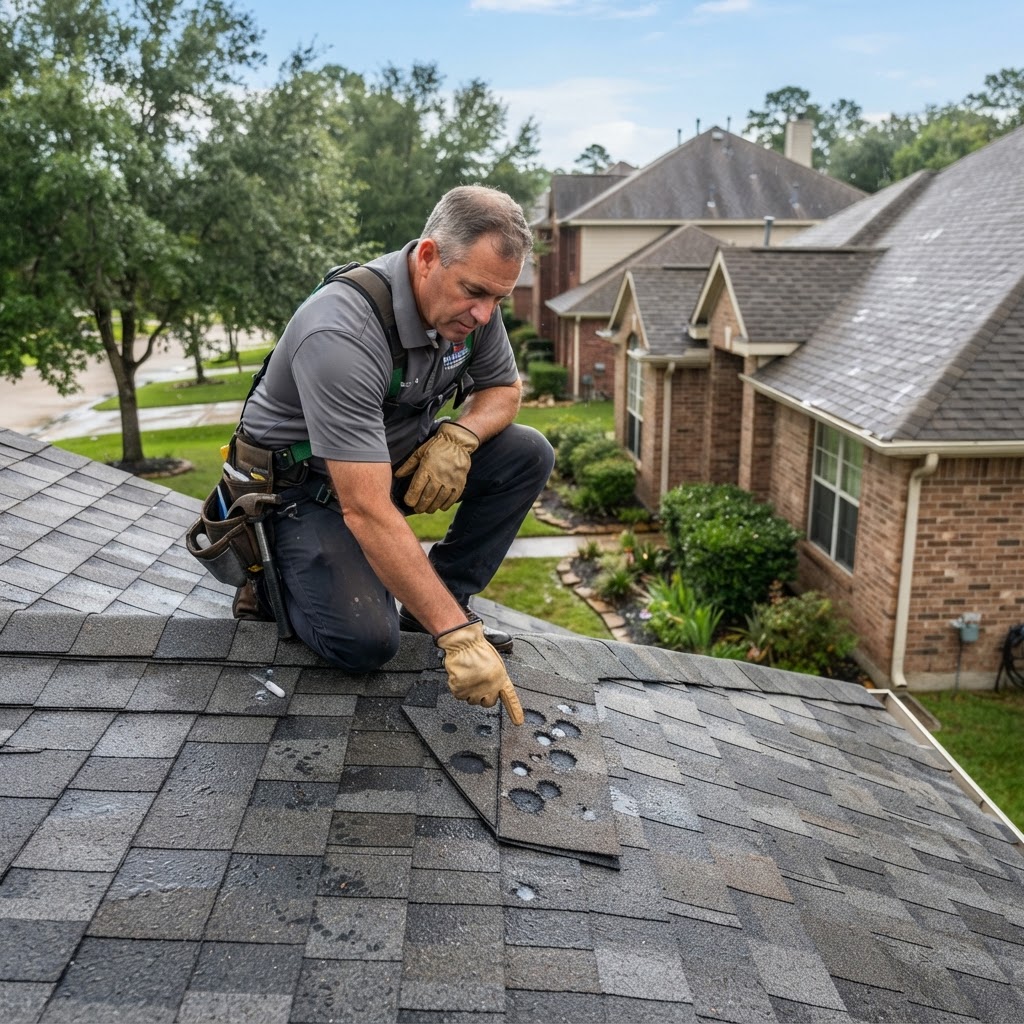
Look for hail hits on shingles using a chalk circle method. Crouch down and look across the shingle surface at a low angle — this raking light technique makes impact craters visible that you'd never see standing upright. When you find one, circle it with chalk. Adjusters use this method too, and it signals that you know what you're doing.
What a genuine hail hit looks like on an architectural shingle:
- A roughly circular area of missing or displaced granules
- A slightly soft, bruised depression in the mat underneath (press gently with your thumb — a fresh hit feels softer than the surrounding shingle)
- Exposed black asphalt mat at the center
What it does NOT look like:
- Cracking along tab lines (that's usually thermal cycling or age)
- Missing shingles at the edges (usually wind, not hail)
- Streaking or algae staining (definitely not hail)
Count and photograph hits per 10-square-foot section. Insurance companies typically use 8–10 hits per 100 square feet as a threshold for functional damage requiring full replacement. Document enough sections across multiple roof planes to establish a pattern.
Step 4: Check the Flashing — Especially on Older Conroe Homes
This one surprises people. Conroe sits on expansive clay soils. That means your foundation moves — sometimes seasonally, sometimes after drought years like 2022–2023 when Montgomery County saw prolonged dry spells followed by heavy fall rain. Foundation movement transfers stress to your walls, and wall movement affects step flashing and chimney flashing.
A hailstorm is not the only thing that opens up flashing gaps. But insurance adjusters sometimes attribute active leaks to pre-existing flashing issues rather than storm damage, denying the claim. Your defense: photograph your flashing now, after the storm. If it's lifted, separated, or bent from hail impact, document it clearly. If the leak started after the storm and the flashing was compromised by impact, that's a covered event.
Step 5: File Your Claim With Documentation in Hand
Once you've gathered:
- Soft metal dent photos with scale references
- Granule accumulation photos at gutters/downspouts
- Chalk-circled shingle hits across multiple roof planes
- Flashing condition photos
- A screenshot of the storm report from a service like Hail Trace or iCatastrophe (free basic searches available)
...then call your insurance company. You're not guessing anymore. You have a documented case.
Request that your adjuster visit be scheduled at least 5–7 days out. This gives you time to get an independent contractor inspection before the adjuster arrives. A reputable roofer will provide a written damage assessment at no charge — this document can be submitted alongside your claim and forces the adjuster to address each item specifically rather than making a blanket judgment.
Typical full roof replacement costs in the Conroe area as of late 2026: $14,000–$22,000 for an average 2,000–2,800 sq ft home using quality architectural shingles with proper underlayment. If your adjuster's estimate comes in at $7,000–$9,000, that's not a partial repair — that's an underpay, and you have the right to invoke your policy's appraisal clause.
The One Thing That Changes Everything
The homeowners who get fair settlements after Conroe hailstorms are not the ones who called the first storm-chaser truck that showed up on their street. They're the ones who documented first, understood their policy's RCV vs. ACV language, and came to the claims process informed.
Your roof is likely your most expensive asset after your home's structure itself. Treat the documentation process with the same seriousness you'd give a car accident claim.
If you'd like a second set of eyes before your adjuster visits, the team at FairClaims Roofing & Construction offers free post-storm inspections throughout Conroe and Montgomery County. No obligation, no pressure — just an honest written assessment you can use however you need it.
Need a roof inspection?
FairClaims Roofing & Construction offers free inspections across the Texas Triangle.
Click to Call