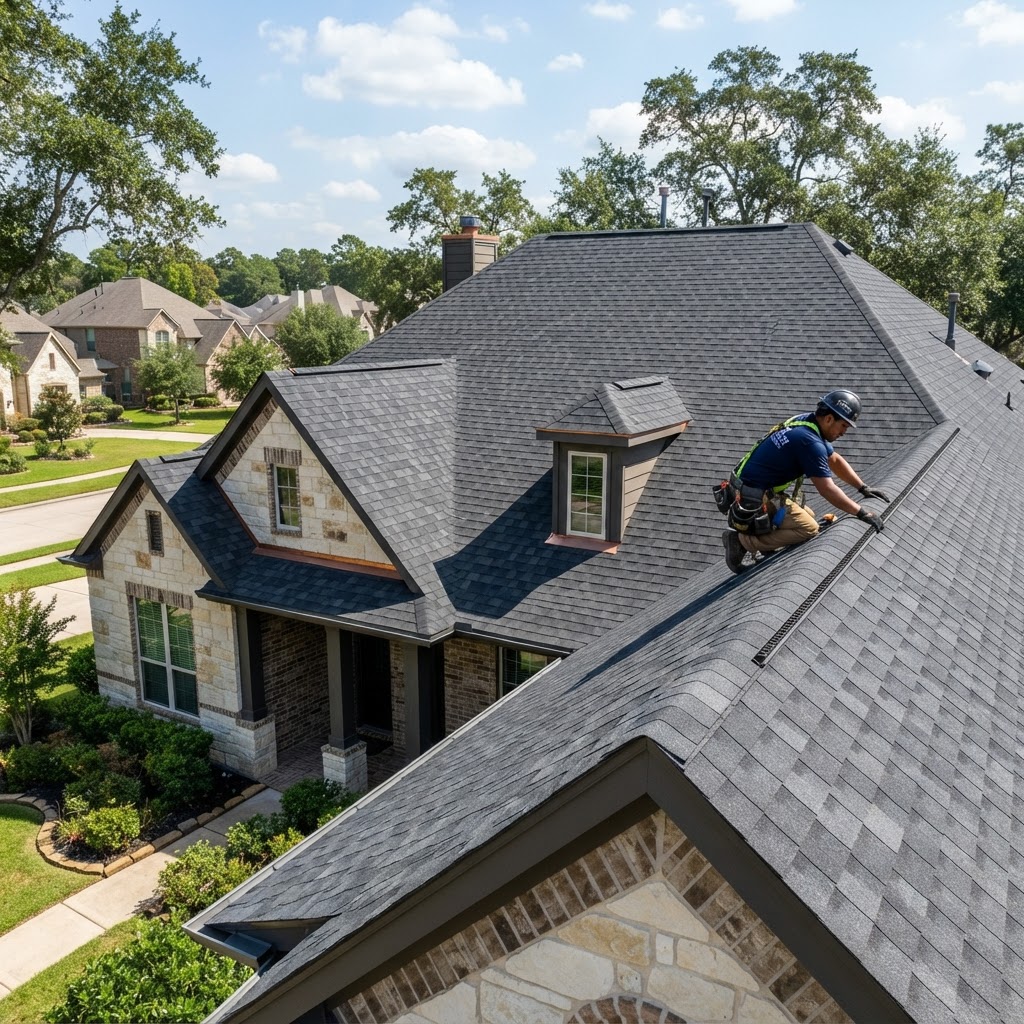
Conroe Attic Moisture Is Quietly Destroying Your Roof From the Inside Out — Here's How to Stop It
Most Conroe homeowners blame storm damage when their roof fails early. But the real culprit is often hidden above the ceiling: attic moisture that rots decking, degrades shingles from below, and voids manufacturer warranties before the first hailstone ever falls. Here's how to diagnose it, fix it, and make sure it never comes back.
If you've lived in Conroe for more than a summer, you already know the humidity is relentless. What most homeowners don't know is that the same oppressive moisture that fogs up your glasses when you step outside is also working its way into your attic — and silently destroying your roof system from the inside out.
In 20-plus years of climbing roofs across Montgomery County, I've seen more premature roof failures caused by attic moisture than by hail, wind, and UV damage combined. The frustrating part? Almost every one of those failures was preventable.
Why Conroe Is Especially Vulnerable
Conroe sits in a climate pocket that punishes roofs in a way most other Texas cities don't. You've got:
- High baseline humidity averaging 75–80% throughout summer, often spiking above 90% after a rain event
- Thermal shock cycles — attic temperatures in a poorly ventilated Conroe home routinely hit 160°F in July, then plummet during winter cold snaps (remember the February 2021 freeze event that hammered Montgomery County)
- Dense tree canopy in neighborhoods like April Sound, Panorama Village, and Forest of Oakridge that limits airflow and keeps roof surfaces damp longer after rain
- Slab foundation movement from the local clay soils, which can subtly shift fascia and soffit framing and open up gaps where humid air infiltrates the attic
None of this shows up on your roof from the street. But get up in that attic and you'll see it: dark staining on the decking, deteriorating insulation, and in the worst cases, visible mold colonies spreading across the OSB sheathing.
The Step-by-Step Diagnostic Process
Before you spend a dollar on repairs, you need to know exactly what you're dealing with. Here's how to assess your attic moisture situation properly.
Step 1: Time your inspection correctly. Don't go up there in the afternoon in August — you'll get heat stroke and learn nothing. Do your inspection on a cool morning, ideally 24–48 hours after a significant rain event. That's when moisture evidence is most visible.
Step 2: Bring the right tools. A quality pin-type moisture meter (the Protimeter Surveymaster is the industry standard; expect to pay $150–$200) is non-negotiable. You're looking for wood moisture content readings above 19% — that's the threshold where wood rot and mold become active concerns. Anything above 25% means you likely already have active deterioration.
Step 3: Check these specific locations first.
- Along the eave line near the soffit vents (or where soffit vents should be but aren't)
- At every valley and hip intersection where decking panels meet
- Around any penetrations: plumbing boots, HVAC flue collars, bathroom exhaust fans
- The ridge line, especially if you have an older box vent system rather than a continuous ridge vent
Step 4: Look at your insulation. Compressed, matted, or discolored insulation is a red flag. Blown-in cellulose that has turned dark and clumped together has absorbed moisture and is no longer doing its job. In Conroe's climate, you want a minimum of R-38 — most older homes in the area are sitting at R-19 or less.
Step 5: Count your vents and do the math. The standard building science formula is 1 square foot of net free area (NFA) of ventilation for every 150 square feet of attic floor space (or 1:300 if you have a vapor barrier). Pull out your phone, measure the attic square footage, and count your soffit and ridge vents. I cannot tell you how many Conroe homes I've been in where the builder installed decorative soffit returns that have no actual ventilation function whatsoever — they look like vents but they're sealed. Tap them. If they sound solid, they're not working.
The Most Common Fix Homeowners Get Wrong
Here's something that surprises most people: adding ridge vents without also adding adequate soffit intake ventilation makes your moisture problem worse, not better.
Ventilation is a pressure system. Hot, humid air exits through the ridge, but only if cooler outside air is actively being drawn in through the soffits below. If your soffit intake is blocked or inadequate, adding ridge vents just creates negative pressure that pulls conditioned air from your living space into the attic — which is full of moisture from your showers, cooking, and breathing. You've essentially turned your HVAC system into a humidity machine that deposits moisture directly onto your decking.
The fix has to be balanced. In most Conroe homes I work on, the corrective sequence looks like this:
- Clear or install functional soffit vents — in a continuous perforated aluminum soffit, or individual vents spaced per code in a wood soffit system
- Install a proper continuous ridge vent — GAF's Cobra Ridge Vent products are what we spec on most jobs; the Cobra Exhaust Vent 4 is excellent for homes with hip roofs where a full ridge run isn't possible
- Seal all attic bypasses — this means caulking or foaming around every light fixture, top plate gap, and penetration between your living space and attic before addressing ventilation
- Verify bathroom exhaust fans terminate outside — not into the attic, which is shockingly common in homes built in Conroe between 1985 and 2005
- Bring insulation up to current standards — R-38 minimum; R-49 if you're in the older parts of Conroe with minimal shade
What This Costs (Real Numbers)
I know homeowners hate vague answers, so here are actual ranges for Conroe-area work as of mid-2026:
- Soffit vent installation or clearing: $300–$800 depending on linear footage and soffit material
- Continuous ridge vent replacement (from box vents): $600–$1,400 for a typical 2,000 sq ft home
- Full attic bypass air sealing: $800–$1,800 (this is often the highest-ROI item on the list)
- Blown-in insulation top-up to R-49: $1,200–$2,500 depending on current depth and attic square footage
- OSB decking replacement in affected sections: $4–$7 per square foot installed — which is why catching this early matters so much
If you catch the moisture issue before the decking is compromised, you're looking at a $2,000–$4,500 total remediation. If the decking has already deteriorated and needs replacement, you're often looking at a full re-roof at $12,000–$22,000 — and your shingle manufacturer's warranty may be void because the failure originated from improper ventilation, which is specifically excluded in most GAF, Owens Corning, and CertainTeed warranty language.
The Insurance Angle Nobody Tells You
Here's something that matters specifically in Montgomery County: if your roof fails and you file a claim, your adjuster's engineering report will note whether improper ventilation contributed to the damage. Companies like State Farm, Allstate, and USAA have all tightened their subrogation language in Texas over the past three years. If the report indicates that moisture-related deterioration was a pre-existing, owner-neglected condition, they can and will reduce or deny your claim — even if a hail event was the proximate cause of the visible damage.
FairClaims Roofing & Construction sees this scenario play out regularly in the post-storm season. Getting a ventilation assessment done proactively isn't just about protecting your roof — it's about protecting your right to file a valid claim when the next round of spring hail comes through.
Your Next Step
If your Conroe home is more than 10 years old and you've never had an attic moisture assessment done, that's your starting point. It doesn't require a full roof inspection — just someone with a moisture meter and the knowledge to interpret what they find. Schedule that assessment before fall humidity season gives way to winter condensation cycles, which is when moisture damage tends to accelerate most rapidly in Montgomery County attics.
A good contractor will give you a written ventilation calculation showing your current NFA versus what's required for your attic square footage. If they can't produce that number, keep looking.
Need a roof inspection?
FairClaims Roofing & Construction offers free inspections across the Texas Triangle.
Click to Call