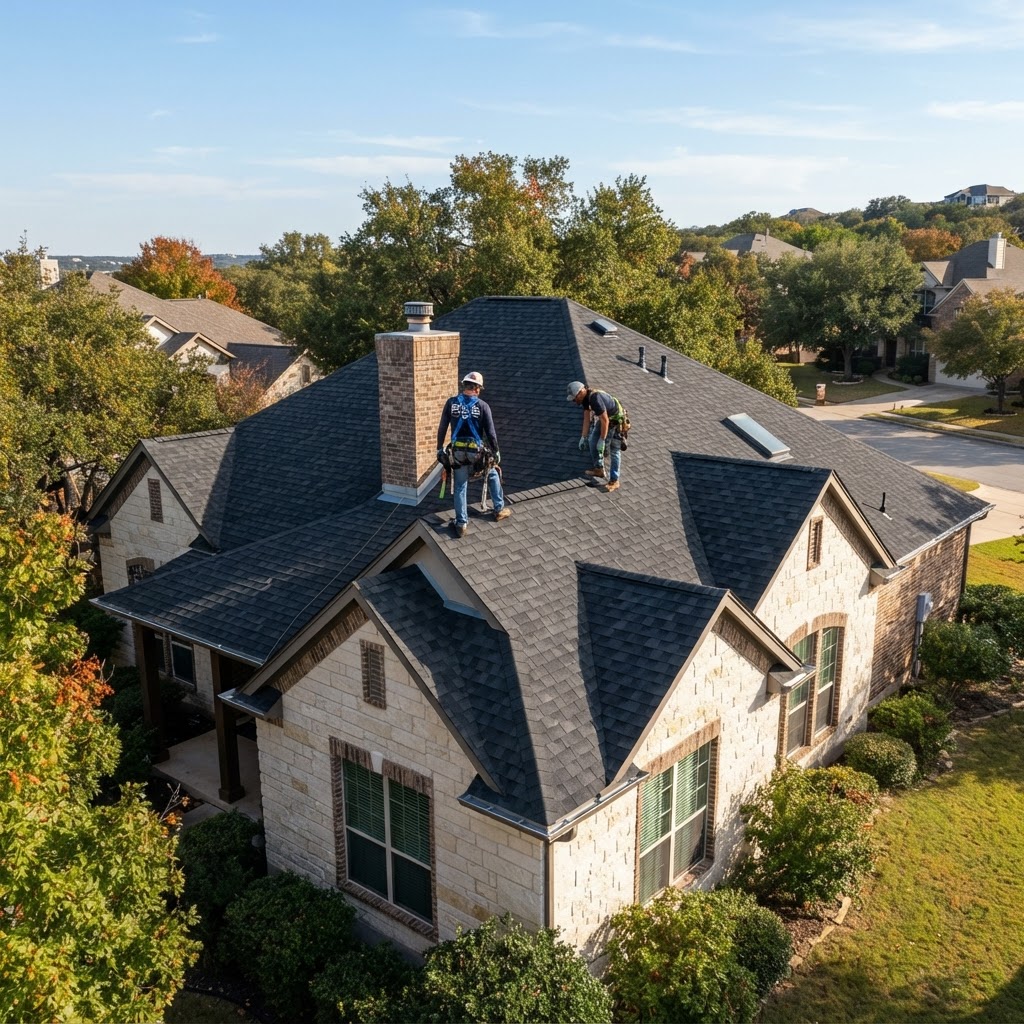
Austin's Fall Roof Checklist: What to Do Before Blue Northers and Spring Hail Season Hit
Austin homeowners face a brutal one-two punch every year — UV-scorched summers followed by sudden freeze events and violent spring hailstorms. Here's an expert seasonal checklist with specific, actionable steps you can do yourself before the next storm rolls through.
If you've lived in Austin long enough, you know the rhythm. June through August bake your roof at 160°F+ surface temperatures. Then somewhere around late October, the first blue norther drops temps 40 degrees in six hours. By March, the Hill Country starts launching baseball-sized hail into the Arboretum and Round Rock without much warning.
Most roofing articles give you the same recycled advice: "check for missing shingles" and "clean your gutters." That's fine as far as it goes. But after 20+ years and thousands of inspections across Central Texas, we can tell you there's a lot more happening on your roof that a generic checklist misses. Here's what actually matters going into fall 2026.
Why October Is the Right Time for This Checklist
Austin's hail season runs roughly March through June, but there's a secondary window in October and November when cold fronts collide with Gulf moisture and spin up fast-moving supercells. The May 2024 storms that tore through Cedar Park and Pflugerville? Those dropped golf ball hail with almost no warning. The October window is real.
More importantly, any damage your roof sustained during the spring and summer — micro-fractures in shingles, compromised flashing, dried-out pipe boot collars — has had months to quietly worsen under intense UV exposure. October is your last realistic inspection window before cold weather makes repairs difficult and before roofers get slammed with spring claims.
What You Can Safely Do Yourself
1. Ground-Level Visual Inspection (Start Here)
You don't need to get on your roof to spot serious warning signs. Walk the full perimeter of your home with binoculars and look for:
- Shingle granule loss — Look in your gutters and at the ground around downspout exits. A cup or more of granules after a rain event is significant. GAF Timberline HDZ shingles (common on homes built after 2015) have a StainGuard Plus coating that degrades visibly when granule loss accelerates.
- Lifted or cupped shingle edges — Texas heat cycles cause asphalt to expand and contract repeatedly. On south- and west-facing slopes, look for shingles curling upward at the tabs. This is a sign the mat is drying out.
- Exposed nail heads or shiner nails — Glint in morning sunlight means a shingle has backed off its fastener. Water infiltration follows.
- Sagging ridge line — A wavy ridge often indicates decking issues underneath, not just surface wear.
2. Attic Inspection — Don't Skip This
This is the step most homeowners ignore, and it's where we find the most surprises.
On a hot afternoon (not after a rain event), go into your attic and look for:
- Daylight coming through the decking — If you can see sky, so can water.
- Staining or dark streaks on rafters — Even old, dry staining tells you where water has entered. Mark the spots with chalk and cross-reference to the roof area above.
- Soft or spongy decking when you press on it — Active rot or delamination in OSB decking is a major red flag.
- Attic ventilation check — Austin homes with inadequate soffit-to-ridge ventilation trap heat and humidity that accelerates shingle aging from the underside. If your attic smells musty in October, that's a problem.
The insight most homeowners don't know: OSB decking (used in virtually every home built after 1995) begins to delaminate when its moisture content cycles above 19% repeatedly. You don't need a leak to get there — inadequate attic ventilation alone can do it over several years. By the time you see interior ceiling stains, you're often looking at full decking replacement, not just shingles.
3. Inspect Pipe Boots, Flashing, and Penetrations
If you're comfortable on a single-story roof with proper footwear (rubber-soled, no sandals, dry conditions only), this is worth doing:
- Pipe boot collars — The rubber Neo-Seal or Perma-Boot collars around plumbing vents crack and shrink under Austin's UV exposure, typically within 7–12 years. Run your finger around the collar. If it flakes or feels brittle, it needs replacement. This is a $75–$150 repair that prevents a $3,000+ interior water damage claim.
- Step flashing at dormers and walls — Look for lifted metal, missing caulk, or rust. On homes near Barton Creek or Lake Travis where live oak debris accumulates, flashing corrosion moves fast.
- Chimney flashing — Austin's expansive clay soils cause foundation movement that translates up through the structure. We regularly see chimney flashing that's pulled away from the mortar joints on homes in Westlake Hills and the 78746 zip code specifically. Even a 1/8-inch gap here is a water entry point.
4. Gutter and Drainage Audit
- Clear gutters of live oak and cedar elm debris — these trees drop heavily through October and November in Central Texas.
- Check that downspouts extend at least 6 feet from the foundation. Austin's clay soils don't absorb water quickly, and pooling near the foundation contributes to the movement that damages flashing (a cycle worth understanding).
- Look for gutter seams pulling apart. If your gutters are sectional (most homes before 2010), the joints are your weak point. Seamless aluminum gutters run $8–$14 per linear foot installed in the Austin market.
5. Document Everything Photographically
This is not optional if you have homeowners insurance. Take dated photos of your roof's current condition every fall. If a hailstorm hits in March and your adjuster tries to argue pre-existing damage, timestamped photos from October are evidence in your favor. State Farm, Allstate, and USAA have all tightened their hail claims processes in Texas since 2022. Documentation is your first line of defense.
Store photos in a labeled cloud folder, not just your phone's camera roll.
What to Watch for This Winter Specifically
- Ice damming is rare in Austin but not impossible — The February 2021 freeze caused ice damming on thousands of Central Texas homes that had never experienced it. If we get another extended freeze event, watch your eave lines during the melt phase.
- Wind-driven rain from northers — Unlike summer storms that come from the south and west, blue northers push rain hard against north-facing slopes that rarely see direct weathering. These are the slopes where flashing problems hide longest.
Repair Cost Reality Check for Austin in 2026
- Pipe boot collar replacement: $75–$150 per penetration
- Flashing repair (step or chimney): $250–$600 depending on scope
- Partial shingle replacement (up to 10 squares): $800–$2,000
- Full roof replacement (2,000 sq ft home, GAF Timberline HDZ, standard pitch): $14,000–$20,000 in the Austin market
- OSB decking replacement (per sheet): $85–$130 installed
These ranges reflect the current Austin labor and material market. Costs in Dripping Springs and Bee Cave run about 10–15% higher due to access and HOA permitting complexity.
One Clear Next Step
If your roof is more than 10 years old or took any hail this spring, the single most valuable thing you can do is schedule a professional inspection before Thanksgiving. At FairClaims Roofing & Construction, our inspections are free and we'll give you a written condition report — not a sales pitch. That report is useful whether you decide to file an insurance claim, plan a repair, or simply want a baseline for future documentation.
You can handle a lot of this checklist yourself. But having a second set of trained eyes — someone who's been on thousands of Austin-area roofs — often catches the one thing that turns a $200 flashing repair into a $12,000 interior remediation. Don't let October slip by without acting on it.
Need a roof inspection?
FairClaims Roofing & Construction offers free inspections across the Texas Triangle.
Click to Call