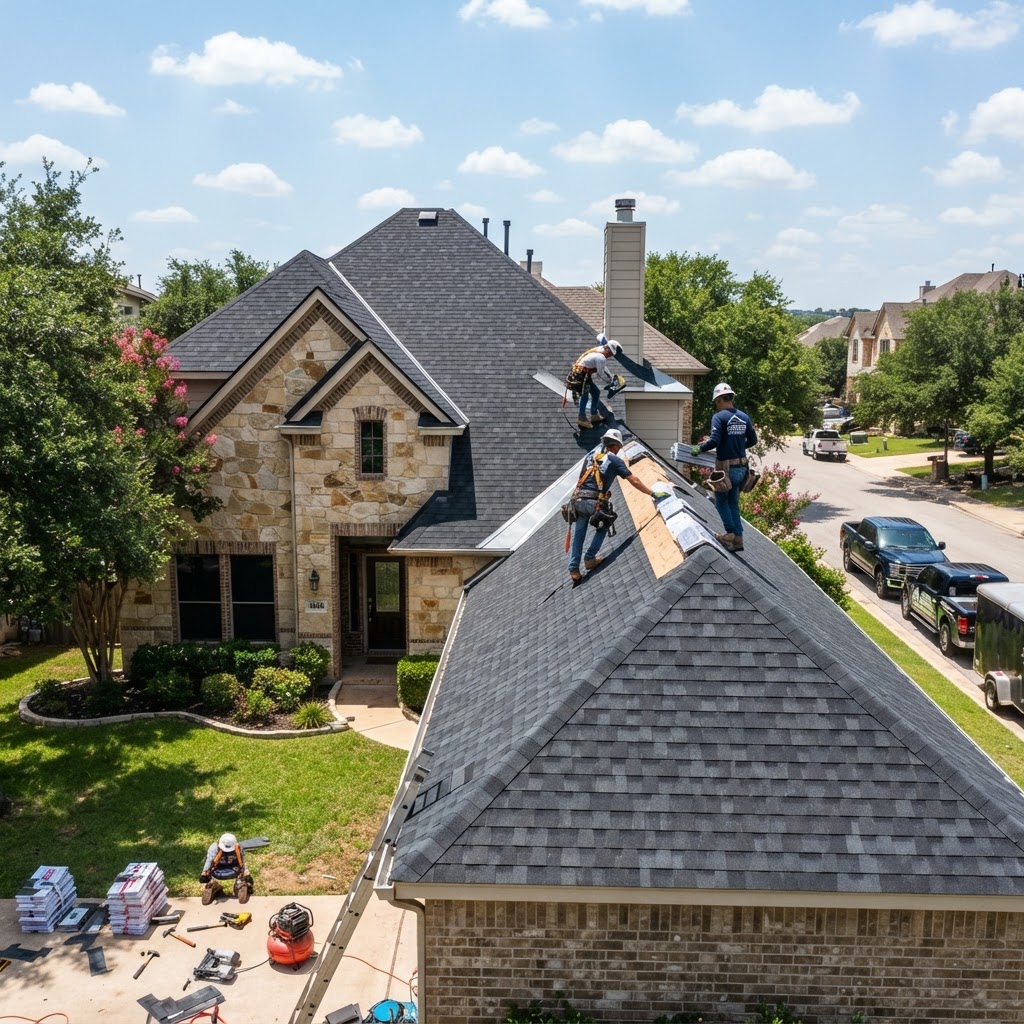
Austin Roof Replacement After Storm Damage: Real Cost Breakdowns and What's Actually Driving Your Quote
If you've gotten three wildly different quotes after an Austin hailstorm, you're not alone. Here's what a 20-year Texas roofer actually sees on the line items — and why the cheapest number is rarely the one that saves you money.
If a pop-up storm rolled through Cedar Park, Round Rock, or South Austin last spring and left dimples on your gutters and bruised shingles on your roof, you've probably already had a few contractors knock on your door. Maybe you've gotten quotes ranging from $8,000 to $22,000 for what sounds like the same job. That spread isn't a mistake — it reflects a real difference in what's being priced, and knowing how to read it can save you thousands.
Let's break down what storm damage roof replacement actually costs in the Austin metro, what moves that number up or down, and a few things most contractors won't tell you upfront.
What a Full Storm Damage Roof Replacement Costs in Austin (2026 Numbers)
For a standard single-story Austin home — think a 2,000–2,400 sq ft house with an 8:12 pitch, one layer of existing shingles, and moderate hail damage — here's what you're realistically looking at:
- Materials + labor (entry-level 3-tab or basic architectural): $9,500–$13,500
- Mid-range architectural shingles (e.g., GAF Timberline HDZ®): $13,000–$17,500
- Premium impact-resistant shingles (e.g., GAF Timberline CS™ or Owens Corning Duration FLEX®): $17,000–$23,000+
- Tear-off of existing layer: Add $1,200–$2,500 depending on deck condition
- Decking replacement (damaged OSB or plank boards): $80–$120 per sheet, often 10–30 sheets on hail-damaged roofs
- Code upgrades (drip edge, ice & water shield, ridge vent): $800–$2,500 depending on current City of Austin permit requirements
Those numbers assume standard conditions. Austin has a habit of throwing non-standard conditions at roofing crews, which we'll get into below.
The Five Factors That Actually Move Your Austin Roof Quote
1. The Storm That Hit You Matters — A Lot
Not all hailstorms are created equal. The April 2016 San Antonio–to–Austin hail event produced stones up to 4.5 inches — baseball-sized — and destroyed entire roofing systems in Pflugerville and Kyle. The 2019 and 2021 Williamson County events were smaller (0.75–1.25 inch) but high-velocity, which tends to bruise the asphalt mat without fully cracking it. Insurance adjusters respond differently to each scenario.
If your roof took dime-sized hail (0.75") at a steep pitch, you likely have functional damage that's harder to photograph but absolutely real. Adjusters from carriers like State Farm and Allstate will sometimes scope only the obvious hits — a savvy contractor walks the adjuster to the ridge caps, the vents, and the flashing, where evidence accumulates faster.
2. Roof Pitch and Accessibility
Austin's older neighborhoods — Tarrytown, Bouldin Creek, East Austin bungalows — often have steep 10:12 or 12:12 pitches. Crews can't walk those without jacks and boards. Expect a steep-slope charge of $50–$100 per square (a "square" = 100 sq ft). On a 30-square roof, that's $1,500–$3,000 added before a single shingle goes down.
Multi-story homes in areas like Westlake Hills and Steiner Ranch compound this further. Two-story surcharges typically run $200–$400 additional per square depending on access.
3. What's Under the Shingles (And It's Often Worse Than Expected)
Here's something that surprises a lot of Austin homeowners: the Barton Springs clay soil that makes your yard look great is the same expansive clay that causes your foundation to shift seasonally. Foundation movement telegraphs directly to your roof deck and, critically, to your step flashing and valley flashing. We routinely find flashing on Austin homes that has cracked, lifted, or completely separated from movement — damage that was there before the storm and gets blamed on the storm by insurers who want a reason to underpay.
A proper scope accounts for flashing replacement. A cheap one skips it. If your quote doesn't line-item chimney flashing, pipe boots, and valley metal, ask specifically — those are the first places you'll see a leak in year two.
4. Attic Ventilation (Austin's Hidden Cost Driver)
Austin's summers are brutal — 100°F+ days are routine from June through September. A poorly ventilated attic in Austin can hit 160°F, which bakes shingles from the inside out and voids manufacturer warranties. If you're replacing your roof and the existing ventilation doesn't meet GAF's or Owens Corning's Net Free Area requirements, adding ridge vents and intake vents isn't optional — it's required to honor the warranty.
Expect to add $600–$1,800 for ventilation upgrades on a typical Austin home. Contractors who skip this conversation are either cutting corners or don't understand how quickly Austin heat kills a new roof.
5. Insurance Scope vs. Real Scope
This is the one most homeowners don't understand until it's too late. Your insurance adjuster writes a scope — a line-item estimate — based on Xactimate software pricing. That pricing is updated quarterly, but it almost always lags behind real Austin market labor costs, especially after a large storm event when every crew in Texas is working and rates spike.
In 2026's Austin market, Xactimate's labor rates for roofing run approximately 15–25% below what quality crews are actually charging. That gap can be negotiated through a supplement — a formal request to the insurer for additional funds backed by documentation. Experienced contractors know how to document and submit supplements; inexperienced ones eat the difference and cut corners.
The Impact-Resistant Shingle Decision (It's About More Than the Storm You Just Had)
One of the smartest decisions an Austin homeowner can make after a storm replacement is upgrading to a Class 4 impact-resistant shingle, such as the GAF Timberline CS™ or the Malarkey Vista® AR. Here's why this matters financially:
- Texas Department of Insurance regulations require most carriers to offer a discount for Class 4 IR shingles — often 15–30% off the wind/hail portion of your premium.
- In Austin, annual premiums for homes with roofs in storm corridors can run $3,500–$6,000+. A 20% discount saves $700–$1,200 per year.
- The upgrade cost from standard HDZ to a Class 4 product typically runs $1,500–$3,000 on a full replacement.
- Break-even: 2–3 years. After that, you're ahead — and your next hail claim starts in a much better position.
Most contractors don't volunteer this calculation. Do the math with your insurance agent before you sign off on standard shingles.
What to Ask Before You Sign Any Contract
After 20+ years on Texas roofs, these are the questions that separate informed homeowners from ones who call us to fix someone else's work:
- Is your labor warranty separate from the manufacturer warranty? A GAF System Plus warranty (which covers both materials and labor up to 50 years) requires a GAF Master Elite® certified contractor. Ask for the certification number — don't take their word for it.
- Are you handling my supplement, and do you charge for it? Reputable contractors handle supplementing as part of the job.
- What's the decking replacement price per sheet, and is it written into the contract? Verbal assurances mean nothing at 8 AM when the crew finds rotten OSB.
- Who pulls the permit? In Austin, roofing permits are required for full replacements. If a contractor suggests skipping it, walk away.
- Will you walk the adjuster's inspection with me? This one question tells you more about a contractor's experience than any review.
One More Thing Nobody Tells You About Austin Storm Claims
Austin sits on the edge of what meteorologists call the "Hail Alley" extension — the corridor stretching from north Texas south through the I-35 corridor. Pop-up supercells that form over the Hill Country frequently track northeast directly over Bee Cave, Dripping Springs, and southwest Austin with almost no warning. The hail from these events is often small but wind-driven at 60–80 mph, meaning it hits your roof at an angle — which bruises the north and east faces of ridges in ways that vertical impact hail doesn't.
This matters because adjusters are trained to look for vertical impact patterns. Horizontal or angled impact from wind-driven hail requires a different inspection approach — and knowing this can be the difference between a full approval and a denial.
If you're navigating a storm damage claim in the Austin area and want a second set of eyes on your adjuster's scope or your contractor's quote, the team at FairClaims Roofing & Construction offers no-pressure storm assessments. We'll tell you honestly what we see — including if your roof doesn't warrant a full claim. Start with a free inspection and get a clear picture before you commit to anything.
Need a roof inspection?
FairClaims Roofing & Construction offers free inspections across the Texas Triangle.
Click to Call