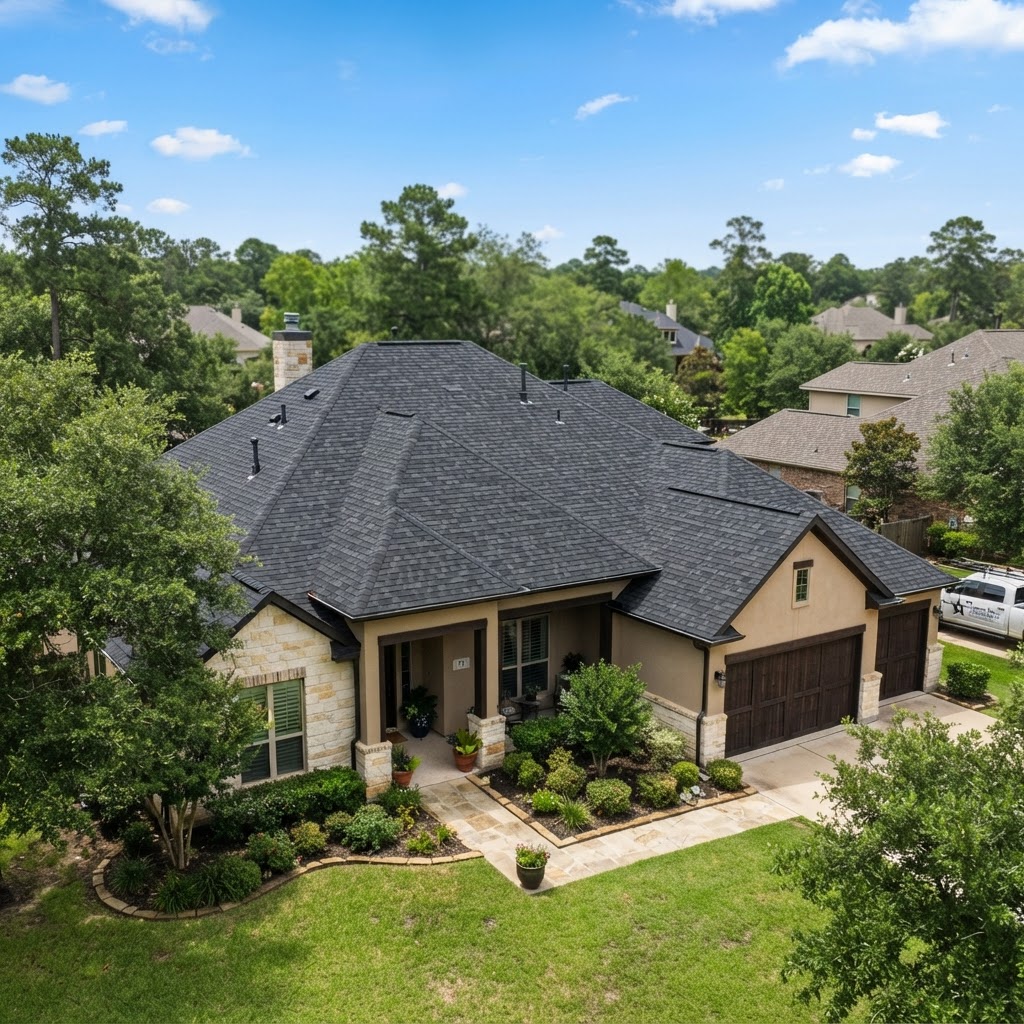
Architectural vs. Impact-Resistant Shingles in The Woodlands: Which One Actually Makes Sense for Your Roof (and Your Insurance Bill)
Not all shingles are created equal — and in The Woodlands, where hail seasons hit hard and summer heat bakes roofs for months on end, the difference between architectural and impact-resistant shingles can mean thousands of dollars. Here's what 20 years on Texas roofs taught us about making the right call.
If you've gotten a roofing estimate recently in The Woodlands, you've probably been handed two options that look similar on paper but carry very different price tags: standard architectural shingles (sometimes called dimensional or laminate shingles) and Class 4 impact-resistant shingles. The sales pitch for the upgrade is usually something vague like "they hold up better in storms." That's technically true, but it doesn't help you make a $15,000 decision.
Let's break this down the way we'd explain it standing in your driveway — with real numbers, real products, and real context for what living under a Texas sky actually does to a roof.
What "Architectural" Actually Means (and What It Doesn't)
Architectural shingles replaced the old three-tab shingles as the industry baseline starting in the late 1990s. They're thicker, heavier, and have that dimensional shadow-line look you see on most homes built in The Woodlands after 2000. Products like GAF Timberline HDZ, Owens Corning Duration, and CertainTeed Landmark are the workhorses of this category.
For most of the country, a quality architectural shingle with a solid underlayment installation is plenty. But most of the country doesn't sit in the corridor between the Gulf of Mexico and Tornado Alley.
Here's what those shingles face in Montgomery County specifically:
- Summer UV exposure that routinely pushes roof-surface temperatures to 160–180°F for 4–5 months straight, accelerating granule loss and accelerating the oxidation of the asphalt binders
- Pop-up hail events — not just the named storms, but the fast-moving supercells that drop golf-ball hail on The Woodlands while it's sunny in Conroe. April through June is peak season, but we've pulled storm-damaged shingles off roofs in every month of the year here
- High ambient humidity that works its way into attic spaces and, when paired with poor ventilation, causes the shingle decking to swell and shrink cyclically — which loosens fasteners and stresses the shingle mat over time
- Foundation movement — this one surprises homeowners — The Woodlands sits on expansive clay soils. When foundations shift seasonally, it creates subtle but real stress on step flashing around chimneys and dormers, which eventually opens gaps that compromise the whole roof system
Standard architectural shingles handle the first three adequately for their rated lifespan. It's the hail piece where the calculus gets interesting.
What Makes a Shingle "Impact Resistant" (Class 4 Specifically)
The UL 2218 test standard is how shingles earn their impact rating. A Class 4 rating — the highest — means a 2-inch steel ball dropped from 20 feet didn't crack the shingle in two consecutive hits at the same spot. That's the test. It's not a hurricane simulation, it's not a Texas hailstorm simulation, but it's the accepted industry standard and it does correlate meaningfully with real-world hail performance.
Products worth knowing by name in this category:
- GAF Timberline® CS (StainGuard Plus) — GAF's Class 4 line, compatible with their System Plus and Golden Pledge warranties
- Owens Corning Impact 10™ — a newer entrant with a 130 mph wind rating baked in
- CertainTeed Landmark IR — solid performer, and CertainTeed has strong distributor relationships in the Houston market so material availability is generally better than some competitors
- Malarkey Legacy® — a polymer-modified shingle that deserves more attention than it gets; the rubberized polymer content genuinely changes how the shingle absorbs impact rather than cracking
The Malarkey point is worth pausing on. Most Class 4 shingles achieve their rating by being thicker and denser. Malarkey's polymer-modified products are engineered at the material level — the asphalt itself behaves more like rubber under impact. In our experience on re-inspections after hail events, these hold up differently than the standard Class 4 products. Whether that justifies the premium depends on your situation.
The Insurance Discount: Real Numbers for Montgomery County Homeowners
Here's the part that can actually change your math. Most major carriers writing policies in Montgomery County — State Farm, Allstate, USAA, and several of the Texas-specific carriers like Texas Farm Bureau — offer premium discounts for Class 4 roofs. The range we see homeowners report is 20–35% off the wind/hail portion of their premium.
That wind/hail portion varies by policy, but for a typical $4,000–$5,500 annual homeowner's premium in The Woodlands zip codes (77380, 77381, 77382, 77384, 77385, 77386, 77389), the wind/hail component is often the largest single piece. A 25% discount on that portion realistically pencils out to $400–$900 per year in savings for many households.
Upgrade cost difference between standard architectural and Class 4 on a typical 2,500–3,000 sq ft Woodlands home: $1,800–$3,200 more depending on product and roof complexity.
Break-even at $600/year in savings: roughly 3–5 years. On a 30-year roof, that math is not close.
Critical caveat: Call your insurance agent before you sign a roofing contract. Ask specifically: "Does my policy offer a discount for a UL 2218 Class 4 rated shingle, and what documentation does your underwriter require to apply it?" Some carriers require the shingle to appear on their approved product list. Get the answer in writing. We've seen homeowners install Class 4 shingles and not capture the discount simply because the paperwork wasn't handled correctly at the time of installation.
When Standard Architectural Shingles Still Make Sense
Don't let anyone tell you Class 4 is always the right answer. Here's when standard architectural shingles are the smarter call:
- Your home is in a trust or estate situation and you're selling within 5 years — you won't recapture the upgrade cost, and buyers rarely pay dollar-for-dollar for roofing upgrades
- Your insurance carrier doesn't offer a Class 4 discount — some regional carriers and certain policy types don't; if the discount isn't there, the premium math disappears
- Your roof deck has structural issues that need to be addressed first — spending up on premium shingles over compromised decking is backwards prioritizing
- Budget constraints are real — a properly installed standard architectural shingle by a qualified contractor beats a poorly installed Class 4 every single time. Installation quality is not optional regardless of product tier.
One More Thing Most Contractors Won't Tell You
The shingle is roughly 40% of your roof's performance story. The other 60% is underlayment, ventilation, flashing details, and fastener pattern. We've inspected Class 4 roofs installed by cut-rate crews that failed in ways the shingle manufacturer would never warranty — not because the shingle failed, but because ice-and-water shield was omitted at valleys, or ridge vents were blocked during installation, or step flashing was caulked instead of properly lapped.
When you're comparing bids, ask each contractor specifically: what underlayment product are you using, what's your ventilation plan, and are you replacing all pipe boot flashings? If they can't answer those questions clearly, the shingle brand on the estimate is irrelevant.
What to Do Next
If your roof is more than 10 years old or took any hits during the April–May 2026 hail season that moved through Montgomery County, it's worth having a licensed contractor do a written inspection before your next renewal date — not a "free inspection" where someone is fishing for a claim, but a genuine condition assessment. FairClaims Roofing & Construction offers documented inspections with photo reports so you have an honest baseline, whether you end up needing work now or in three years.
Start with your insurance agent and that one question about the Class 4 discount. The answer changes everything about which conversation to have next.
Need a roof inspection?
FairClaims Roofing & Construction offers free inspections across the Texas Triangle.
Click to Call