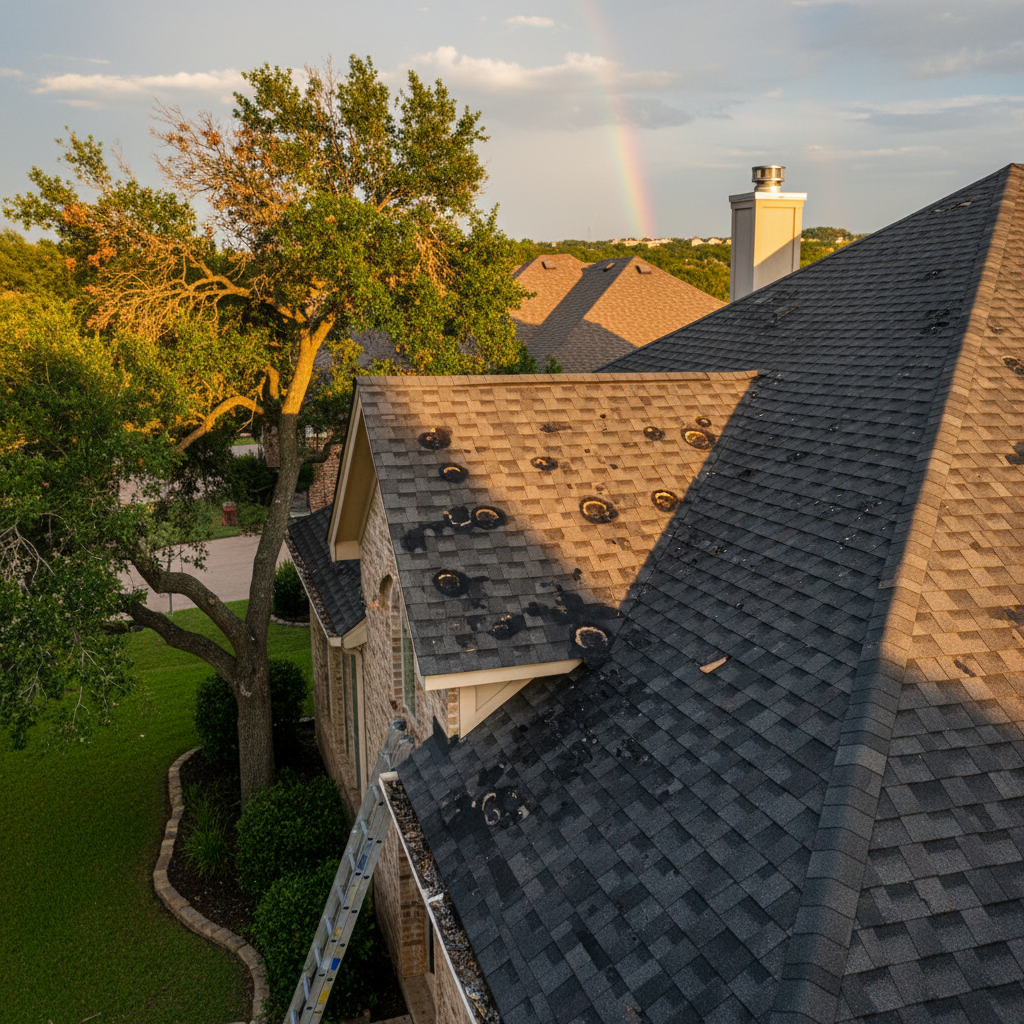
A San Antonio Roof After a Summer Hail Storm: What Actually Happens in the First 72 Hours (And What Most Homeowners Get Wrong)
A real-world walkthrough of what happens after a pop-up hail storm hits your San Antonio neighborhood — from the first dents on your AC unit to the final insurance check. What to do, what to avoid, and what your adjuster won't tell you.
It's a Tuesday afternoon in late May. You're at work, your kids are at school, and a storm cell nobody was really tracking spins up over Bexar County and drops golf ball-sized hail on a six-block swath of your neighborhood in Stone Oak. By the time you get home, your neighbor is already on the phone with a contractor you've never heard of. Your gutters look like a waffle iron pressed them. Your truck has dimples across the hood.
Your roof? You have no idea.
This is the moment most homeowners make decisions that cost them thousands of dollars — not because the storm was so bad, but because they didn't know what to do next. Here's the real sequence of events, step by step.
Step 1: Don't Go on the Roof Yourself
Seriously. I know it's tempting. But wet, granule-covered asphalt shingles after a storm are like sandpaper glued to ice. We've seen homeowners fall. Beyond the safety issue, if you crack a shingle walking around up there, an adjuster can legitimately question whether that damage was pre-existing or self-inflicted.
Instead, do a ground-level assessment first:
- Check your AC condenser fins — hail almost always dents aluminum fins. This is your first visual confirmation hail was large enough to matter.
- Look at your gutters and downspouts for dents and dings along the top edge.
- Check window screens for punctures — screens catch hail hits that shingles might absorb without obvious visible cracking.
- Look at any painted wood trim or fascia boards for fresh impact marks with the paint knocked off.
If your AC fins are dented, your gutters are dimpled, and your screens are punctured, you almost certainly have documentable roof damage. Call a licensed contractor before you call your insurance company.
Step 2: Call a Contractor First — Not Your Insurance Company
This surprises most homeowners, but here's why it matters: your first call to your insurance company starts the clock on your claim. In Texas, once you open a claim, the insurer has 15 days to acknowledge it and 15 business days after receiving all documentation to accept or deny. That timeline puts pressure on you to have your documentation ready.
If you call before you have a contractor's inspection in hand, you're walking into that process blind.
A reputable local contractor (one who actually does insurance work regularly) will:
- Inspect the roof and document damage with dated photos and measurements
- Identify hail strike density per 10-square-foot test area (the standard adjusters use)
- Note secondary damage — cracked pipe boots, damaged ridge cap, compromised flashing at chimneys or skylights
- Give you a written scope of damage before your adjuster arrives
That written scope is leverage. Bring it to the adjuster appointment.
Step 3: Understanding What San Antonio Hail Actually Does to Asphalt Shingles
Here's something that surprises most homeowners: you usually can't see the worst hail damage from the ground, or even from a casual walkover. What hail does to an asphalt shingle is knock off the ceramic granules — those small colored stones embedded in the surface. Those granules are your shingle's UV protection.
San Antonio sits at roughly 1,700 feet of elevation and receives intense UV radiation even by Texas standards. Without those granules, a shingle that might have lasted another 12 years in a milder climate will start cracking and curling within 18–24 months under the South Texas sun. The damage is slow, invisible, and cumulative — until your ceiling has a water stain and you're facing a full replacement anyway.
This is why insurance adjusters are trained to look at granule loss in impact zones, not just visible cracks or punctures. A shingle with a clean, circular granule loss zone about the diameter of a quarter is a textbook hail strike. Multiple strikes per square foot = functional damage = a legitimate claim.
What to know about the shingles on your roof: If your home was built or re-roofed between 2005 and 2018, there's a reasonable chance you have a 3-tab shingle that's already granule-fatigued from years of Texas heat. GAF Timberline HDZ shingles — which carry a Class 4 impact resistance rating and are what most quality contractors are installing in San Antonio right now — have a significantly thicker granule layer and a modified asphalt base designed to absorb impact without shattering the bond. If you're replacing after a storm, this upgrade can also qualify you for a discount on your homeowner's insurance premium (ask your insurer specifically about UL 2218 Class 4 credits — in Texas, these discounts are real and sometimes substantial).
Step 4: The Adjuster Visit — What to Watch For
Insurance adjusters in Texas are under pressure to close claims efficiently. Some are thorough and fair. Some are not. Here's what to watch for:
- Adjuster arrives alone and doesn't let your contractor on the roof with them. This is a red flag. In Texas, you have the right to have your contractor present during the inspection. If they push back, politely insist.
- The estimate only covers partial repair, not full replacement. In Texas, if hail damaged more than a certain percentage of squares (typically 30–40%, though this varies by carrier), most policies require full replacement, not patch repair. Know your policy.
- They miss the pipe boots. Pipe boots — the rubber collars around plumbing vents — are almost always damaged in a hail event and are consistently overlooked. A cracked pipe boot is a direct water intrusion path. Every good contractor will flag these.
- Depreciation math. Texas uses Actual Cash Value (ACV) vs. Replacement Cost Value (RCV) — make sure you know which coverage you have before the adjuster writes the check. ACV policies deduct for age and wear; RCV policies pay to replace at today's material prices after you complete the work.
Step 5: The Part Nobody Talks About — Foundation Movement and Flashing
This is the one that gets San Antonio homeowners more than almost anything else. San Antonio sits on expansive clay soils. In dry summers — and we've had back-to-back drought years recently — that clay shrinks. When it shrinks, foundations move. When foundations move, the framing they're attached to moves. When framing moves, roof-to-wall flashing at dormers, chimneys, skylights, and second-floor transitions can pull away from the sealing surface by fractions of an inch.
Those fractions of an inch don't look like damage. But over a few rain events, water finds them. We've seen water intrusion in homes where the shingles were in perfect condition — the leak source was a flashing joint that had racked 3/16 of an inch off-plane over two dry summers.
If you're getting a post-storm inspection, make sure whoever is on your roof is looking at flashing integrity, not just shingles. This is especially true on homes in Alamo Heights, Helotes, and the Hill Country-adjacent neighborhoods where soil movement is most pronounced.
Step 6: Choosing a Contractor (And Avoiding the Storm Chasers)
After every significant hail event in San Antonio, out-of-state contractors flood the area. Some are legitimate. Many are not. Here's a fast checklist:
- Verify their RCAT (Roofing Contractors Association of Texas) license — it's searchable online
- Check they carry both general liability AND workers' comp — ask for the certificate of insurance, not just a verbal confirmation
- Ask how long they've been operating in Texas — a contractor without local supplier relationships, local warranty registrations, or a local office will be hard to find if something goes wrong in year two
- Never sign an Assignment of Benefits (AOB) agreement — these have been used to strip homeowners of their rights in the claims process
FairClaims Roofing & Construction has been working with San Antonio homeowners through hail claims for years and can attend your adjuster inspection at no charge — not to run your claim for you, but to make sure nothing gets missed on the roof.
What to Do Right Now
If your neighborhood got hit in a recent storm and you haven't had a professional inspection yet, don't wait for a ceiling stain to tell you something went wrong.
Get a free, no-obligation roof inspection from a licensed Texas contractor before you open a claim. Walk into that adjuster meeting with documentation in hand. Know what's on your roof, what it's worth, and what your policy actually covers.
That one step is the difference between a fully funded replacement and a $4,000 out-of-pocket surprise eighteen months from now.
Need a roof inspection?
FairClaims Roofing & Construction offers free inspections across the Texas Triangle.
Click to Call