7 'Minor' Roof Warning Signs San Antonio Homeowners Ignore — That Almost Always Mean a Bigger Problem
That small dark stain on your ceiling or the little lifted shingle you noticed from the driveway? In San Antonio's brutal heat-and-hail cycle, those 'minor' signs are often your roof's last warning before a costly failure. Here's what 20+ years on Texas roofs has taught us to never dismiss.
San Antonio homeowners have a complicated relationship with their roofs. On one hand, the city sits in one of the most roof-punishing climates in the entire country — brutal UV exposure from 100°F+ summers, surprise hail from pop-up storms that can drop golf ball-sized ice in neighborhoods that were sunny an hour before, and the kind of foundation movement that comes from the city's notorious expansive clay soils. On the other hand, because those roofs don't leak dramatically every week, it's easy to rationalize away the little things.
After 20+ years and thousands of inspections across the Texas Triangle, I can tell you with confidence: the small stuff is almost never small in San Antonio. Here are seven warning signs that homeowners consistently underestimate — and what they actually signal.
1. A Single Dark Stain on an Interior Ceiling
Most homeowners see a stain the size of a dinner plate, note that it hasn't grown in a few months, and move on. Here's the problem: roof leaks are not linear. Water entering through a failed shingle or compromised flashing can travel 8–12 feet horizontally along roof decking and rafters before it shows up on your drywall. By the time you see that stain, the wood decking above it has often been cycling through wet and dry conditions for months — or years.
In San Antonio's humid summers, that repeated moisture cycling creates ideal conditions for wood rot and microbial growth. We've opened ceilings expecting to replace a few sheets of OSB decking and found entire 12-foot sections soft enough to push your fist through. A stain that looks stable isn't stable — it's just waiting on the next storm.
What to do: Get into the attic with a flashlight during daylight. Look for daylight penetration, dark streaking on rafters, or soft spots on the decking. If you see any of those, the leak has already been active long enough to cause structural concern.
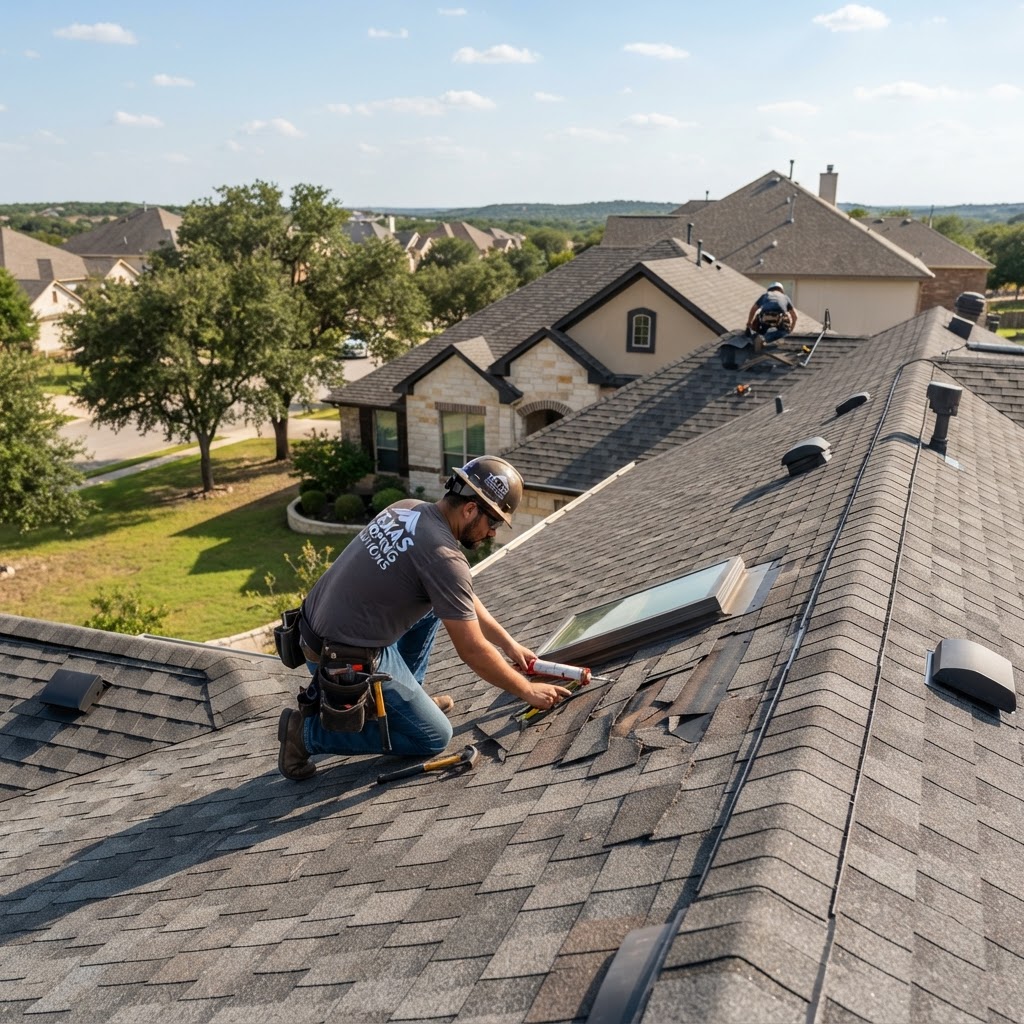
2. Flashing That's 'Just a Little Loose' Around a Chimney or Skylight
Flashing failures are the number one source of non-storm roof leaks we see across Greater San Antonio. And almost universally, the homeowner noticed the flashing looked off months before the damage became visible inside.
Here's the San Antonio-specific wrinkle: the city's expansive Blackland Prairie clay soil causes significant seasonal foundation movement. That movement transfers up through the structure and absolutely affects the flashing joints around fixed penetrations — chimneys, skylights, pipe boots, and HVAC curbs. A flashing that was perfectly sealed two years ago can open up a 1/8" gap from nothing more than a wet summer followed by a dry fall.
That 1/8" gap? In a driving rain event — which San Antonio sees regularly from Gulf moisture surges and tropical remnants — it can admit several gallons of water per hour directly onto your ceiling drywall.
3. Granule Accumulation in Your Gutters (Even a Small Amount)
Asphalt shingles shed granules naturally throughout their life, but the rate of shedding tells you exactly where your roof is in its lifespan. A small handful of granules in the gutter after a rainstorm might not alarm you. It should.
San Antonio's UV index is brutal — the city averages over 220 sunny days per year, and summer roof surface temperatures routinely hit 160–170°F on dark shingles. That heat accelerates granule loss dramatically. Products like GAF Timberline HDZ with StainGuard Plus™ hold up better than standard 3-tabs under this exposure, but even quality shingles lose granules faster here than in comparable climates further north.
Why it matters beyond aesthetics: Granules exist to block UV from reaching the asphalt substrate. Once a shingle loses significant granule coverage, the asphalt degrades, becomes brittle, and cracks — often within 12–18 months of visible granule loss. A shingle that cracks in July in San Antonio doesn't get a gradual leak. It gets a flood during the first convective storm in August.
4. One or Two Lifted or 'Wavy' Shingles Visible from the Driveway
This one gets rationalized constantly: "It's just a couple shingles, the rest look fine." Lifted or cupped shingles are almost never an isolated problem. They indicate one of three serious underlying conditions:
- Inadequate attic ventilation causing heat buildup that bakes the shingles from below (extremely common in San Antonio's older neighborhoods like Alamo Heights, Stone Oak, and Helotes)
- Improper installation — specifically, shingles that were face-nailed rather than nailed in the nail strip, causing them to lift over time
- Moisture-related decking movement where the OSB or plywood underneath has swelled and caused the shingles above to buckle
Any of these three conditions means your entire roof surface is compromised, not just the two shingles you can see from the street.
5. An Insurance Claim Denial After a Hail Storm — Without a Second Opinion
This one isn't a physical warning sign, but it's a warning sign about what's coming financially. San Antonio sits in the heart of Hail Alley, and the city took significant hits in April 2016, April 2019, and the spring 2023 outbreak that moved through the I-35 corridor.
Here's what most homeowners don't know: insurance adjusters use tools like Xactimate that apply regional pricing caps, and first-offer settlements frequently undervalue the actual scope of damage — particularly on roofs where hail caused granule loss and bruising that isn't immediately obvious to the untrained eye. Insurers including State Farm, USAA, and Allstate have all faced Texas litigation over scope and valuation disputes.
A denial or a low settlement offer on a roof after a documented hail event in San Antonio is not the end of the conversation. It's the beginning of one. An independent inspection documenting impact fractures and granule displacement carries real weight in supplement and appraisal processes.
6. Moss or Algae Starting in One Corner
San Antonio gets humid enough — especially in the northern Hill Country fringe neighborhoods like Boerne and Bulverde — for algae growth on north-facing roof sections. Homeowners often mistake it for dirt or treat it cosmetically.
The real problem is underneath: algae and moss hold moisture against the shingle surface, accelerating granule loss and, in heavier growth, physically lifting the shingle edges through root penetration. One corner of algae left untreated for two seasons typically spreads to 40–60% of the affected roof plane.
7. A Roof That 'Passed' a Visual Inspection From the Ground
This is the warning sign about what you didn't do. Ground-level assessments miss flashing separation, nail pops in field shingles, pipe boot cracking, and ridge cap deterioration almost 100% of the time. We've inspected roofs in the Dominion and Stone Oak areas that homeowners were told "looked fine" from the street — and found missing drip edge, exposed fasteners, and failed pipe boots that were actively leaking.
A real inspection means boots on the roof, with photos, documentation of penetrations, and an honest assessment of remaining life. After a hail event, it means a systematic check with a hail gauge and documentation of bruising patterns.
The Bottom Line
San Antonio's climate is unforgiving to roofs — and unforgiving to homeowners who wait for obvious problems before acting. The warning signs above are almost always cheaper to address at detection than after the next storm season completes the damage.
If you've noticed any of these signs on your home, the team at FairClaims Roofing & Construction offers no-obligation roof inspections across Greater San Antonio. We're a GAF Master Elite® certified contractor (top 2% nationwide) and will give you a straight answer about what we find — including an honest assessment of whether your situation warrants an insurance claim or just proactive maintenance.
Next step: Schedule a free inspection before hurricane season peaks in September. Use the contact form on this page or call us directly. No sales pressure — just a thorough, documented look at what your roof is actually telling you.
Need a roof inspection?
FairClaims Roofing & Construction offers free inspections across the Texas Triangle.
Click to Call